Thursday, 15 April 2010

Liberal Conspiracy » Voters want hung parl. than Tory or Labour win

The Times / Populus poll tonight shows the Conservative lead slipping to 3pts. The Tories are at 36%, Labour at% and Libdems on 21%.

More interesting is the general level of annoyance at all three major parties.

The Times reports:

The latest poll shows that 32 per cent of the public now hope for a hung parliament (as opposed to expecting one), against 28 per cent wanting a Tory majority and 22 per cent a Labour one. Lib Dem voters prefer a deal with Labour than the Tories in a hung parliament, by 44 to 31 per cent. The public is evenly split 40 to 42 per cent about whether they want Labour or the Tories in either a majority or a minority government.

Voters were asked to say which party had proposed eight key manifesto pledges. They wrongly identified four: reducing the increase in national insurance contributions (naming Labour not the Tories); allowing unsuccessful schools, hospitals and the police (the Tories, not Labour); tightening up takeover rules (the Tories not Labour); and requiring foreign workers employed in public services to speak fluent English (the Tories not Labour).

In only one case, the £150-a-year tax break, did more than half of voters (60 per cent) correctly identify the party making the proposal.

Which basically confirms my point that most voters don’t really pay attention to policy pledges.

The UK and Hexham needs real democracy instead of the current sham

Posted via web from sunwalking's posterous

Unlock Democracy - Election Manifesto 2010

Election Manifesto 2010

Article posted by Unlock Democracy

Citizen Extra CoverThe upcoming general election will be the most important election in years. After years of scandals, ranging from ‘cash for honours’ through to the recent expenses crisis, party politics has never been held in greater disrepute. All party leaders now say they accept that we can’t go on like this, but which parties are offering real change, rather than just the illusion of it?

In a major new initiative, Unlock Democracy will be conducting a survey over the coming weeks to assess to what extent the parties are committed to democratic reform.

Over the next few pages we outline what we think should be done. We’ll be using this list to benchmark each of the parties’ own policies.

Unlock Democracy is committed to pushing this agenda in the run up to the election and beyond – but we need your help. Please raise these issues with your constituency candidates so that they know that people care about the state of politics. And please consider donating to our general election campaign so we can spread the word as widely as possible.

Download Citizen Extra: General Election Manifesto

Posted via web from Hexham Matters

Wednesday, 14 April 2010

Unlock Democracy - an activist group that young people should be supporting - check them out

About Us

Unlock Democracy (incorporating Charter 88) is the UK’s leading campaign for democracy, rights and freedoms. A grassroots movement, we are owned and run by our members. In particular, we campaign for:

  • Fair, Open and Honest Elections
  • Rights, Freedoms and a Written Constitution
  • Stronger Parliament and Accountable Government
  • Bringing Power Closer to the People
  • A Culture of Informed Political Interest and Responsibility

Unlock Democracy was founded in November 2007 following the merger of Charter 88 and the New Politics Network (see history). In this section you can also find out more about our constitution, how we are funded, staff and governing bodies.

Finally, we also have a network of local groups across the UK.

Click on link to go to the UnlockDemocracy site.

Posted via web from Hexham Matters

Are you Christian? - 'Tory manifesto has ‘God-shaped hole’' says Ekklesia

David Cameron has been left facing an embarrassing situation today following the launch of the Conservative manifesto, which makes no reference to religion, faith, faith schools or the contribution of church or other religious groups to society.

It comes after an interview on Radio 4’s Today Programme on Saturday, when David Cameron spoke about the importance of his faith. He has also given a number of interviews to church groups and publications in the last few weeks speaking about the importance of religious groups in society. In a video interview for Christians in Politics he spoke of the important role of churches in "fixing broken Britain". In response, the religion and society thinktank Ekklesia warned that the churches risked being co-opted for electoral advantage.

In the run up to the election all three party leaders contributed to a book for churches setting out their beliefs, and were interviewed about the role that churches play in society. In a video interview for Faithworks released at the weekend David Cameron said “I want to see a big growth in faith-based organisations and charities” and said “I think we should celebrate them”. The book published a few weeks ago entitled ‘No Spin, Sleaze or Scandal…Just politics’ was produced by Christian MPs, and featured David Cameron speaking about the important role of churches and faith groups.

In stark contrast to the Tory manifesto Labour’s manifesto launched yesterday, states: “Faith is enormously important to millions of people in Britain, shaping their values and the way they live. We respect the importance of belief and welcome the contribution that people of faith make to our communities and society more widely. We will actively combat extremist groups who promote fear, hatred and violence on the basis of faith or race.”

Click on link to read the Ekklesia artcle

Posted via web from Hexham Matters

Tuesday, 13 April 2010

If you are young start focusing on what really matters - check this out

Total oil refinery

Surplus oil production capacity could disappear by 2012 a report from US Joint Forces Command, says. Photograph: Katja Buchholz/Getty Images

The US military has warned that surplus oil production capacity could disappear within two years and there could be serious shortages by 2015 with a significant economic and political impact.

The energy crisis outlined in a Joint Operating Environment report from the US Joint Forces Command, comes as the price of petrol in Britain reaches record levels and the cost of crude is predicted to soon top $100 a barrel.

"By 2012, surplus oil production capacity could entirely disappear, and as early as 2015, the shortfall in output could reach nearly 10 million barrels per day," says the report, which has a foreword by a senior commander, General James N Mattis.

It adds: "While it is difficult to predict precisely what economic, political, and strategic effects such a shortfall might produce, it surely would reduce the prospects for growth in both the developing and developed worlds. Such an economic slowdown would exacerbate other unresolved tensions, push fragile and failing states further down the path toward collapse, and perhaps have serious economic impact on both China and India."

The US military says its views cannot be taken as US government policy but admits they are meant to provide the Joint Forces with "an intellectual foundation upon which we will construct the concept to guide out future force developments."

The warning is the latest in a series from around the world that has turned peak oil – the moment when demand exceeds supply – from a distant threat to a more immediate risk.

To read Terry Macalister's article in the Guardian click on link.

The only candidate with a really comprehensive grip in Hexham is Dr Steven Ford - vote for him on May 6th

Posted via web from Hexham Matters

The value of depression - article from DailyGood

In the midst of winter, I finally learned that there was in me an invincible summer. --Albert Camus

Upside of Depression:
It's everywhere. As inescapable as the common cold. Every year, 7 percent of us will be diagnosed with the grey clouds of depression. But how well do we really understand it? Charles Darwin claimed that depression was a clarifying force, focusing the mind on its most essential problems. And the grey clouds hit him hard, leaving him "not able to do anything one day out of three." More recently, researchers say that depression has a secret purpose, and it's best to ride out, rather than conceal, the pain. Like a fever that helps the immune system fight off infection, depression might be an unpleasant yet adaptive response to affliction. Maybe Darwin was right. We suffer- we suffer terribly- but we don't suffer in vain. [more]

Be The Change:
Feeling blue? Reflect on afflictions in your life that might be triggering you to withdraw.

Click on link to sign up to the DailyGood

Posted via web from sunwalking's posterous

Make My Vote Count - MPs cannot duck change

Remember, Remember the 5th of November ... duckhouses, POWER and pullouts.

http://VoteForAChange.co.uk/10000

On 5 November the Vote for a Change campaign floated a model of a duck house down the River Thames to Westminster. For those inside Parliament, the message was simple: 'you can't duck change'. There is no possibility of effective self regulation at Westminster. The fundamental questions - like how we hire and fire our MPs - can't be left to politicians. But it can be left to the voters on Election Day with a referendum on the voting system.

This action is one of a series of campaign activities piling up the pressure on MPs in the run up to the Queen's Speech on 18 November. Our activities range right the way from a meeting next week with Gordon Brown and one-to-one lobbying of Labour MPs; to supporter emails to a "rogue's gallery" of high profile electoral reform opponents; taking the Gravy Train to MPs of all parties who are roadblocks to reform; and getting 60 young people together outside Parliament dressed as zombie politicians for a Halloween stunt.

http://www.voteforachange.co.uk/blog

Adding another notch to our lobbying of Labour MPs and decision-makers, this coming week's edition of the New Statesman magazine contains a 32-page pullout section on electoral reform. You can pick up a copy of the New Statesman from your local news stand.

We've also set an ambitious goal: 10,000 letters to those MPs who are resisting reform and propping up our rotten political system for their own benefit. Can you help us reach 10,000 today by sending a letter now?

Click on link to read much more - and support VoteForAChange

Posted via web from sunwalking's posterous

BBC News - Parties 'failing' to use web well

Cross on election ballot, BBC
Younger voters are keen to talk to parties online

Political parties are failing in their efforts to use the internet to campaign, a survey has suggested.

Carried out by the National Endowment for Science, Technology and the Arts it shows a gap between what voters want and what they get from the parties.

Of those questioned, 79% could not recall any material - adverts, e-mails or websites - that had been prepared for the internet by the main parties.

Despite this, 40% said they wanted more chance to interact with parties online.

Campaign tools

The number of those keen to engage online rises to 60%, found the survey, among 18-24 year-olds, who are more likely to be on the web.

It also found that 25% of voters were unimpressed with the way political parties use the internet.

Click on link to read article

Posted via web from Hexham Matters

Monday, 12 April 2010

Extraordinary response to Dr Steven Ford & his campaign team in Hexham

The campaign team spoke to hundreds of Hexham folk on Saturday.

Steve held an 'open surgery' for the many people who wanted to discuss issues and the need for a new form of truly democratic and accountable politics.

He is of course the only candidate with more than two decades of service to the people of the constituency, having been a GP for thousands of constituency people.

He isn't a barrister and he wasn't imposed by London - and he won't disappear after he's elected as our new MP!

It's your chance to say "NO MORE" to the corrupt parties and 'YES' to the local man who embodies the ethics, values and policies to overturn the system and provide us with a clean 'New Politics'. We are lucky to have such a candidate in Hexham.

On the other hand you could vote Labour or Tory and get yet more of the wonderful Thatcherite garbage that we've had for the last 3 or 4 decades that has brought us to our knees.

Posted via web from Hexham Matters

BBC News - At-a-glance: Labour election manifesto

Labour manifesto cover

Unlike in recent elections, there are no big spending promises as Labour acknowledges the tough economic climate. Included is a promise not to raise income tax, a pledge that was also in the 2005 document - and later broken.

Other plans could see under-performing schools, hospitals and police forces taken over by teams from more successful organisations.

A "toddler's tax credit" would provide £4 per week extra for families with one and two-year-olds from 2012, while all cancer test results would be available within a week, the party promises.

ON THE ECONOMY
  • Secure the recovery by supporting the economy and halving the deficit by 2014 through growth, fair taxes and cuts to lower priority spending
  • A commitment not to raise any of the rates of income tax and not to extend VAT on food, children's clothes, books, newspapers and public transport fares
  • National Minimum Wage to rise in line with average earnings by the end of the next Parliament
  • Government as an employer committed to offering a living wage to staff in all departments. This is currently set higher than the minimum wage at £7.60 an hour
  • Promise to keep business taxes "as low as possible"
  • Realise stakes in publicly-controlled banks, introduce a global levy and reform banking rules
  • An option to turn Northern Rock into a mutual rather than privatising it as part of a wider commitment to building societies

Posted via web from Hexham Matters

Brown's plan to win votes the Blair way - UK Politics, UK - The Independent

Gordon Brown will today execute a remarkable personal about-turn as he embraces Tony Blair's pet policy for freeing hospitals from Whitehall control.

The Labour manifesto will commit a Brown government to transferring power over every hospital to local managers, while hospitals that fail to raise standards within three years will be taken over. Mr Brown will insist his government retains its reforming zeal as Labour seeks to reel in the Conservatives' consistent lead in the polls and achieve a fourth consecutive spell in power.

Although the financial crisis means the Labour manifesto will be devoid of major new spending promises, the Prime Minister will place heavy emphasis on the need to continue "spreading excellence" in public services.

Posted via web from Hexham Matters

Friday, 9 April 2010

264 General Election candidates already committed to equality | The Equality Trust

Houses of Parliament
On the day that the General Election is called, the total number of candidates who have signed the Equality Pledge has reached 264.


Find out whether your candidates have signed [external link]....

... and if not, please use our online tool [external link] to write and ask them to sign.

The Equality Pledge

Compelling new evidence presented by The Equality Trust shows that more equal societies - those with a narrower gap between rich and poor – are more cohesive, healthier, suffer fewer social problems and are more environmentally sustainable. In view of these findings I am committed to making the UK a more equal society as the most effective means of building a better society.  I will therefore actively support the case for policies designed to narrow the gap between rich and poor; and engage with the debate on which measures should be implemented to achieve that aim.

Posted via web from Hexham Matters

Should the UK get rid of its extremes of poverty & wealth? - MP3 interview

Richard Wilkinson and Kate Pickett, academic epidemiologists at Nottingham and York universities respectively, are authors of The Spirit Level: Why More Equal Societies Almost Always Do Better.

They explain why relatively unequal societies such as Britain and the United States are more likely to suffer from a range of problems, including low life expectancy, illiteracy, stress, and a high crime rate. Even climate change is less of a challenge for a society with a narrow gap between rich and poor.

The average voter just doesn't know what's been done to them. Look;

Labour as well as the Tories have been screwing the middle classes as well as the poor for 4 decades.

The lower 50% of the UK population in 1973 owned 12% of the wealth - that by 2003 had fallen to 1% - yes 1%.

Where has the other 11% of the wealth gone - to the mega-rich of course.

"In 1976, excluding property, the bottom half of the UK population owned 12% of the marketable wealth; by 2003 that had fallen to just 1%. In the same period, the
share enjoyed by the top 10% rose from 57% to 71%. Even when property is included, the bottom half of the population still only owns just 7% of the country’s wealth."

Consider the current sickening every-hour TV ads in which the poor are being invited to send in their few bits of gold. Where do you think that value is being transferred to?

As with the National Lottery the blood of the poor is being transfused to the bloated bodies of the mega-rich'

Social justice matters - to everyone - for a programme for a New Politics see HERE This is why in Hexham were supporting Dr Steve Ford - see HERE

SEE

http://www.respublica.org.uk/articles/spend-investment

http://www.timesonline.co.uk/tol/comment/columnists/guest_contributors/article6861008.ece -

http://www.respublica.org.uk/articles/new-tories-will-stop-class-becoming-caste

http://www.ft.com/cms/s/0/742025ee-e5b4-11de-b5d7-00144feab49a.html?catid=2&S...

http://www.statistics.gov.uk/pdfdir/wealth1209.pdf

Posted via email from sunwalking's posterous

Should the UK get rid of its extremes of poverty& wealth? - MP3 interview

Richard Wilkinson and Kate Pickett, academic epidemiologists at Nottingham and York universities respectively, are authors of The Spirit Level: Why More Equal Societies Almost Always Do Better.

They explain why relatively unequal societies such as Britain and the United States are more likely to suffer from a range of problems, including low life expectancy, illiteracy, stress, and a high crime rate. Even climate change is less of a challenge for a society with a narrow gap between rich and poor.

The average voter just doesn't know what's been done to them. Look;

Labour as well as the Tories have been screwing the middle classes as well as the poor for 4 decades.

The lower 50% of the UK population in 1973 owned 12% of the wealth - that by 2003 had fallen to 1% - yes 1%.

Where has the other 11% of the wealth gone - to the mega-rich of course.

"In 1976, excluding property, the bottom half of the UK population owned 12% of the marketable wealth; by 2003 that had fallen to just 1%. In the same period, the
share enjoyed by the top 10% rose from 57% to 71%. Even when property is included, the bottom half of the population still only owns just 7% of the country’s wealth."

Consider the current sickening every-hour TV ads in which the poor are being invited to send in their few bits of gold. Where do you think that value is being transferred to?

As with the National Lottery the blood of the poor is being transfused to the bloated bodies of the mega-rich'

Social justice matters - to everyone - for a programme for a New Politics see HERE This is why in Hexham were supporting Dr Steve Ford - see HERE

SEE

http://www.respublica.org.uk/articles/spend-investment

http://www.timesonline.co.uk/tol/comment/columnists/guest_contributors/article6861008.ece -

http://www.respublica.org.uk/articles/new-tories-will-stop-class-becoming-caste

http://www.ft.com/cms/s/0/742025ee-e5b4-11de-b5d7-00144feab49a.html?catid=2&S...

http://www.statistics.gov.uk/pdfdir/wealth1209.pdf

Posted via web from Hexham Matters

4 Way race in Hexham - but who is missing - has Labour given up the ghost already?

Prospective parliamentary candidates

The 2005 general election

Peter Atkinson, Conservative 17,605 42.4%
Kevin Graham, Labour 12,585 30.3%
Andrew Duffield, Liberal Democrat 10,673 25.7%
Ian Riddell, English Democrats 521 1.3%
Thomas Davison, Imperial Party 129 0.3%
Candidate Votes Share %

Conservative majority: 5,020

Turnout: 68.8%

The 2001 general election

Get rid of the corrupted parties - be Independent, vote Independent - vote Dr Steven Ford in Hexham.

Posted via web from sunwalking's posterous

Why Independents can win - including Dr Steve Ford in Hexham

The biggest argument against Steven Ford winning the Hexham seat, is the viewpoint that voters are too attached to the political parties, which they have always voted for. But is this true? The graph below shows that research done at Essex University demonstrates that there has been a steady decrease in the electorate's attachment political parties since 1964. (Graph from The Dynamics of Party Identification Essex University 2003)

The Dynamics of Party Identification

These figures only show the period from 1964 to 2001. This is before the many recent scandals in Westminster. It has not yet been possible to fully measure the effect of these. However, what is abundantly clear is that there is deep anger and disgust at everything from duck houses to the mortgage fiddles. There is outrage that the money from our taxes has been used in this way. We can have no doubt but that this downward trend in support for political parties has been accelerated.

Voters are more willing than at any time in recent British history to turn away from the parties they have supported. That gives Independents an opportunity they have not had for a century and a half, which was when the party system, as we know it, was formed.

A candidate of the quality of Steven Ford has not only the possibility of winning but has a good chance of doing so. Steven Ford can win because he represents the changing attitudes in Britain.

Posted via email from sunwalking's posterous

Thursday, 8 April 2010

One country, Two Parliaments, Two Elections - from the Electoral Reform Society

Gordon Brown has finally confirmed what we’ve all known for months. We’re facing a general election on May 6th

You can read the Society’s response here. But what could be a better way to get started than to start crunching some of the numbers – on the 382 MPs who’ve already won office, no campaign required. Here’s a taster.

So with the starter’s pistol fired, we know the results in most of our parliament. Well think of it as the parliament within a parliament – and if parliamentary careers are anything to go by, these are the seats held by future residents of Number 10, Number 11, and the big offices in the Treasury and the FO.

We haven’t come across some decent research on the length of parliamentary careers at Westminister.  Discussions of resettlement grants for MPs has the average length of service at 8.5 years in 2001, and 8.5 in 2002.  Whether MPs in ‘two term marginals’ make up for the decades of undefeated service in safe seats is a subject for another post.

So, we’ve already got this parliament the start with:

Britain’s ‘Safe’ Parliament
Party Safe Seats %
Con 172 45.03%
Lab 165 43.19%
LD 29 7.59%
PC 2 0.52%
SNP 3 0.79%
Northern Irish others 11 2.88%
TOTAL 382

That’s a pretty hefty slice of the lower House already taken. Regionally the picture is uniformly bad, but with some variations. Where these characters come from is another matter.

Safe Regions
Government Office (GO) Region Seats Decided Total Seats % Seats Decided
East of England 41 58 70.69%
East Midlands 21 46 45.65%
London 45 73 61.64%
North East 21 29 72.41%
Northern Ireland 11 18 61.11%
North West 43 74 58.11%
Scotland 36 59 61.02%
South East 55 84 65.48%
South West 24 55 43.64%
Wales 24 40 60.00%
West Midlands 28 59 47.46%
Yorkshire and Humberside 33 54 61.11%
TOTAL 382 649 58.86%

You can draw your own conclusions from here on where the key battlegrounds are. The PM did make a point of heading straight from Buck Palace to Kent, and two key marginals.  Better still, check out the data,  and we’ve done it for you. Kent’s a funny one. We’ve had to congratulate their voters today for being lucky enough to buck the local and national trend, and only have just over 1/2 their seats in the bag.  That’s pretty good by our standards.

The total population of these safe seats is 25 million. It seems fair to assume that for their voters this is looking like a quiet election. For the rest, particularly those lucky 1 million odd in 3 way marginals there will be a campaign. There’s a case for popping Hampstead and Kilburn in alongside, but we’ve been pretty conservative with our choices, and gave into temptation not to lump the next tranch of pseudo marginals as ‘SAFE’

Name Region County Electorate Incumbent
Norwich South EE Norfolk 72,538 LAB
Watford EE Hertfordshire 80,013 LAB
Derby North EM Derbyshire 71,370 LAB
Northampton North EM Northamptonshire 61,749 LAB
Ealing Central and Acton LN 69,149 LAB
Poplar and Limehouse LN 70,880 LAB
Edinburgh South SC 58,811 LAB
Ochil and South Perthshire SC 75,576 LAB
Brighton Pavilion SE East Sussex 72,234 LAB
Bristol North West SW Avon 73,104 LAB
Filton and Bradley Stoke SW Avon 68,763 **
York Outer YH North Yorkshire 74,797 **
**new seat

Posted via web from sunwalking's posterous

Do we need any greater proof that the party system is all washed up? - Vote for a Change - vote Independent

Wich is the worst Party so far as Fair Voting is cocerned? The Tories of course - but Labour is nearly as bad.

Thank God in Hexham we have an outstanding Independent candidate - Dr Steven Ford - SEE http://www.stevenford.co.uk/

Posted via web from Hexham Matters

Martin Bell discusses independents and the Independent Network

In Hexham we are fortunate enough to have an outstanding Independent candidate Dr Steven Bell

Posted via web from Hexham Matters

Martin Bell Letter of support for Independent Candidates & Independent-Minded Voters | Independent Network

Let's make 6 May 2010 Independents' Day

An open letter to independent candidates and independent-minded voters.

I am writing on behalf of the Independent Network, the organisation that helps Independents help each other.

Independents have an unprecedented opportunity on 6 May to change the face of politics for good.  The MPs' expenses scandal has discredited many individual MPs, the parties that allowed it to happen and the House of Commons itself.  Many MPs with questionable expenses records have not been de-selected by their parties.  It is up to the voters to complete the process.

This is a time for independents to challenge the politics of the status quo; it is a time for independent Councillors either to stand for Parliament themselves or to help in the campaigns of others; it is a time to support the Independent Network by sending contributions to http://www.independentnetwork.org.uk/get-involved/donate

It is a time for the election of a group of MPs, without party baggage but with real world experience, to be a force for honest politics in the New House of Commons.  They will be answerable not to a political party but only to their constituents and their consciences. It won't be easy, but I believe that it is do-able.

If not us - who?  And if not now - when?

Yours Sincerely,
Martin Bell

Hexham & the UK - BE INDEPENDENT! - get the politicians to grow up and start working together - Labour & the Tories have screwed us for too long.

Posted via web from Hexham Matters

iPad review from the Guardian editor

Click on link to go to Guardian

Posted via web from Hexham Matters

Liberal Conspiracy » Labour abandons plans to ditch FPTP voting

The Indy reports:

Moves to stage a referendum on scrapping the first-past-the-post electoral system have been abandoned as the parties wrangle over legislation to be rushed into law ahead of the general election.

The Government has also dropped proposals to phase out the right of hereditary peers to sit in the House of Lords.

The Government yesterday said it had given up hope of pressing ahead with measures to hold a referendum on whether to move from “first-past-the-post” to the “alternative vote” system under which voters list candidates in their order of preference. Tory frontbenchers in the Lords had criticised the plans, set out in the Constitutional Reform and Governance Bill.

It was always going to be too good to be true wasn’t it.

According to Vote for a Change, Conservatives were reported to have refused offers of a sunset clause, and were prepared to adopt a ‘scorched earth policy’ vetoing the whole CRAG bill if the referendum wasn’t dropped.

Willie Sullivan, head of the Vote for a Change campaign said in a statement last night: “In Wash Up and armed with a veto not granted them by any voter, the Conservatives have killed reform of the voting system and reform of the House of Lords. Cameron’s message is clear. And it isn’t change.”

Posted via web from Hexham Matters

Wednesday, 7 April 2010

Top Tory's VAT plan would leave poorest 30% worse off | Left Foot Forward

Boris Johnson’s deputy mayor, Kit Malthouse, yesterday suggested that direct taxes should be replaced with VAT. The policy would result in an astonishingly regressive shift in the tax system.

In yesterday’s Times, Malthouse wrote:

“Whichever way you look at it, cash is on the way out, and this means an indirect, universal sales tax could be on the way in, as a replacement for all direct taxes. The amount of tax collected may well be the same, but the big benefit would be an end to the mindless game of cat and mouse among politicians, corporate Britain, the Inland Revenue and the long-suffering public.”

The wisdom of the policy has been questioned by Paul Waugh, Next Left and the Daily Mirror but the full horror of its regressive nature is only just becoming clear. Analysis carried out for Left Foot Forward by Howard Reed using ONS data shows the distributional impact of replacing direct taxes such as income tax and employee national insurance with VAT. The chart shows that the poorest families would be hit with a 30 per cent tax hike while the richest would face a 9 per cent tax cut. Reed estimates that VAT would have to rise to 55 per cent to cover the loss in income tax and NICs.

Malthouse has form on hair-brained tax schemes.

Click on link to read the full article

Posted via web from Hexham Matters

Tuesday, 6 April 2010

Support Unlock Democracy

The premise of Unlock Democracy is simple: far too much power is locked up in the hands of far too few people. In particular, we want to:

Unlock Government:

The combination of the inherited powers of feudal monarchs, modern media's concentration on the Prime Minster and overuse of the party whip has turned Britain in to one of the most centralised countries in Europe. Governments have become locked in a vicious circle of centralising power in an effort to improve public services, only to find this leads to increased dissatisfaction. The quango state - unelected and unaccountable bodies which have a direct impact on ordinary people's lives - has become a common feature of our political life.

Unlock the Constitution:

Despite advances such as the creation of the Human Rights Act, a simple majority in the House of Commons can curtail our rights and freedoms by changing our unwritten constitution. At a time of heightened security and fear of terrorism we believe that Britain needs a new constitutional settlement in which basic rights and freedoms are entrenched.

Unlock Political Parties:

Representative democracy is in long-term decline. However, instead of simply taking the populist stance that polticial parties are part of the problem, we need to recognise the important role they play in connecting the vast majority of voters to our political system. Unlock Democracy will be a critical friend of the political party: while being honest about its limitations, we will embrace its potential for encouraging greater participation. This means reforming the way parties are funded to incentivise meaningful engagement and talking up party activity as a public good rather than some sort of anti social behaviour.

Unlock Decision-making:

Participation is about more than consultation. Nothing encourages cynicism more than a public body asking for views on an issue that has already been decided upon. The public should be given a real say in issues that concern them, using tools that provide genuine engagement such as Citizens' Juries. But such tools are expensive and can only involve a limited number of people at any one time. Citizens should be given the right to petition for Parliamentary debates, public inquiries and, where necessary, referendums on issues that concern them.

Unlock Democracy will continue campaign for individual reforms such as a predominantly elected Second Chamber and initiatives such as the Sustainable Communities Bill, and will play our part in reskilling the political process by holding events such as People and Politics Day. Ultimately however, we have two main goals in mind:

A Citizens' Initiative Act

This would give citizens the right to initiate legislation and public inquiries at a local or national level if enough people -say 5% - call for it. If the elected body concerns fails to respond satisfactorily, the petitioners could trigger a binding referendum. Unlock Democracy plans to draft and table a Parliamentary Bill outlining this process within the next few months

A Citizen's Convention

The UK needs a Constitutional Convention look at how the various tiers of government work together and to consider the entrenchment of basic rights and freedoms. However, such a convention must not be made up of the Great and Good. It needs to be created and agreed by the citizens of the United Kingdom because ultimately it is their freedoms and interests which it will serve and protect.

Unlock Democracy will work closely with any individual or organisation which shares our desire to unlock power and to change the nature of British democracy. Furthermore, as both Charter 88 and the New Politics Network are membership organisations, we practice what we preach: by joining both or either organisations you will be given a say in and a vote on what our priorities should be.

Click on link to find out more

Posted via web from Hexham Matters

Monday, 5 April 2010

A tiny Tax on Bankers would solve painful cuts - check this out.

Check on link to find out more about the Robin Hood tax - so simple, so brilliant, SO FAIR!

Posted via web from Hexham Matters

Sir Bob says disengagement, not apathy

Sir Robert Worcester is a Visiting Professor of Government at LSE and an Honorary Fellow. He founded MORI in 1969.

The Hansard Society recently launched “Audit of Engagement 7: The 2010 Report with a focus on MPs and Parliament” which contains the results of the Ipsos MORI survey carried out last November. This provides a look at the state of British public opinion in the run-up to the impending election to take place on May 6th.

It is my intention to file several blogs sharing my analysis of the Audit survey to this site, not so much as the Founder of MORI, the polling agency, but as a Visiting Professor in the Department of Government at LSE.

In this first Worcester’s Blog, I offer some good news from work carried out by MORI for nearly 40 years which counters received wisdom about people’s interest in politics.  There is a wide-spread believe that dismay, even disgust, towards politics and politicians is widespread, a growing cancer in the state of the nation, and a threat to our democracy.  To some degree this is true, but it is in my contrarian view based on values research that it is temporary and if radical action is taken in the near future in addition to that taken recently by the Parliament, which only scratched the surface of reform.

There is no question about an erosion of voting, the evidence is clear.  (Chart 1):

When the turnout dropped precipitously between the 1997 election (‘Labour’s Landslide’) and 2001 (‘Labour’s Second Landslide’) and hardly recovered in 2005 (‘Labour’s Landslip’, which I defined as a ‘small landslide’), politicians and pundits quickly blamed ‘apathy’.  It wasn’t apathy, it was disengagement. There was no decline whatsoever in interest in politics.

Click on link to read fascinating article

Posted via web from Hexham Matters

Election campaign begins today - Roland Watson in Times Online

Number 10 Downing Street
to not show photographer information -->

(Oli Scarff/Getty Images)

to not show image description -->

Let the race begin

here with the id "dynamic-image-navigation" is used so that the innerHTML can be written to by the JS call below. -->

Gordon Brown will travel the mile from Downing Street to Buckingham Palace today and launch the most fiercely contested election campaign for a generation.

He awill ask the Queen to dissolve Parliament next Monday and will name May 6 as the day voters decide his fate.

Within minutes the frenzy of electoral combat will begin. Mr Brown will make a symbolic trip to the South East, showing his determination to hold on to new Labour gains of 1997. David Cameron will head in the opposite direction, taking the fight to Labour in the Midlands and the North.

The formalities between the Prime Minister and the monarch will take only a few minutes but will trigger the most eagerly awaited showdown since Tony Blair swept away 18 years of Conservative rule in 1997 and what promises to be the most closely fought election since John Major defied the polls and Neil Kinnock in 1992.

Click on link to read article

Posted via web from Hexham Matters

What kind of Hung Parliament? Patrick Dunleavy (LSE)

Mar 262010

Posted by Patrick Dunleavy.

All recent projections are pointing to a hung Parliament – where the top party in the Commons does not have an overall majority (that is, 326 or more out of the 650 MPs). But this term covers  two kinds of very different situations:

1. A shallow hung Parliament would occur if one party gets close to the 326 majority level but does not quite reach it. Bear in mind that for David Cameron, there are a cushion of Northern Ireland seats, with the Unionists of all persuasions likely to support him in office, and the Sinn Fein MPs certain not to show up at Westminster (and so not needing to be covered). These considerations suggest that the lower boundary for a Cameron government with a working ability to pass laws should be put at around 318 seats and not 326. From 317 down to 300 seats for the Conservatives, the Parliament would be shallowly hung – meaning that the Labour party and the Liberal Democrats together would not be able to bring it down on a motion of confidence. Cameron in these circumstances would very likely run a minority government, saying to the Liberal Democrats – “Support us or look unpatriotic, and risk another immediate election”. Given the concentration of executive power in ministers’ hands and the general uselessness of the Commons as any kind of effective legislature, a Conservative minority government is pretty certain to be able to last out until May 2011, when it would call a second general election.

2. A deeply hung Parliament occurs when both the Tories nor Labour get less than 300 seats, and so neither could hope to pass any legislation without seeking the active co-operation of the Liberal Democrats from the word go.

Click on link to read article

Posted via web from Hexham Matters

Sunday, 4 April 2010

Your vote matters - get registerd

BBC News - Grayling suggests B&Bs should be able to bar gay guests

Lib Dems launch 'Labservative General Election Manifesto'

Our re-election pledges
We promise to be dishonest about the spending cuts required to fix the deficit.
We promise to spend billions of pounds on like-for-like replacement of nuclear weapons despite Russia and the U.S. reducing their own stockpiles.
We promise to saddle students with debt for their university education.
We promise to guard our ‘safe seats’ by blocking electoral reform.
We promise to protect corrupt MPs from public accountability.
We promise to accept funding from Unions and Big Business in exchange for political influence.
We promise to make environmental policy an afterthought.

Posted via web from sunwalking's posterous

'Hung Parliament Rules Imminent' - report from Charter 2010

In a flurry of confusion last week, the House of Commons Justice Committee published its report and the transcript of the evidence it received on hung parliaments - full text here. Sir Gus O’Donnell, the Cabinet Secretary, will probably publish the final version of the Cabinet Manual chapter that deals with hung parliaments next week.

Distilling the likely truth from the rumour – which had some journalists implying the material in the Justice Committee report was new (it wasn’t - the hearings were in February and the draft Cabinet Manual chapter was also published then); and others confusing the Justice Committee report with the final version of Sir Gus’ chapter (which he hasn’t yet published) – three important proposals emerge:

# Parliament will apparently be asked to return, after the election, a week later than has been usual in recent times (i.e. on the Wednesday 13 days after polling day), with the vote on the Queen’s Speech the following Monday. This would allow 18 days for negotiations between parties to take place in a hung parliament. By a happy coincidence, when Tom (now Lord) McNally prepared a memorandum for Paddy Ashdown in 1997, he calculated it would take 17 days for an agreement with another party to be arrived at and to be approved by the Liberal Democrat policy processes.

# The "caretaker" rules that govern the actions of ministers during an election (preventing them from taking controversial decisions, signing contracts or making appointments) would be extended through that 18-day period. None of this would, of course, stop crucial decisions being taken on matters like managing the economy, protecting sterling, or a terrorist attack - with consultation with the other parties. As Sir Gus himself pointed out, that a stable government was being formed during this period would be more likely to reassure the international financial community than a rapidly formed and probably short-lived minority government that would have no certainty of its measures passing.

# Civil servants would be allowed to assist all the parties during this period by providing any information needed (for example, on the public finances) to arrive at an agreed programme.

If this turns out to be the substance of Sir Gus’ final document it will represent a sound and sensible framework within which the parties - and civil servants - can work if there is a hung parliament. It will also be in line with the evidence Charter 2010 submitted to two House of Commons committees and to the Cabinet Office.

PLUS CA CHANGE...
When Tom (now Lord) McNally sent his memorandum Negotiating Participation in Government to Paddy Ashdown and Tony Blair in 1997 he subtitled it:
“If it were done when ‘tis done, then ‘twere well it were done quickly. - Macbeth.I.vii.1”

Posted via web from sunwalking's posterous

Saturday, 3 April 2010

Compact Camcorders for adrenaline junkies - BBC NEWS | Programmes | Click

'Capitalism, a Love Story' - Michael Moore trailer

“Capitalism, a Love Story”. Here is the trailer:

Download:
FLVMP43GP

Being the agent provocateur that he is, Michael Moore doesn’t pretend to offer answers in this documentary. Instead, he exposes a broken system by asking a lot of daring questions. One of his main ones is that both capitalism and socialism are constructs 100’s of years old. We are now living in the 21st century – isn’t it time we created a new financial system for today’s world?

And most damning of all: how can we pretend to live in a political democracy when our economy is not democratic? Can we ever have true democracy when the top 5% of Western society control the majority of its wealth? When that top 5% uses money to influence politics to protect the status quo?

For Hexham, for the UK, for the World - a new system is vital.

Posted via web from Hexham Matters

The man who created Cal-Earth - The California Institute of Earth Art and Architecture

Nader Khalili

NADER KHALILI, ARCHITECT AND HUMANITARIAN
(1936-2008)

Architect and author Nader Khalili developed the simple breakthrough building technologies known as Superadobe (sandbags and barbed wire) and Ceramic Houses, with the freely available material of earth, for almost thirty years. Inspired by the poetry of the 12th century mystic Rumi, who wrote in his native Persian language, Khalili served as a consultant to the U.N. (UNIDO) and a contributor to NASA, as well as directing the Architectural Research Program (ARP) at SCI-Arc (Southern California Institute of Architecture).

For his work in Earth and Ceramic Architecture since 1975, he received awards from organizations such as the CCAIA for "Excellence in Technology," the U.N. and HUD for "Shelter for the Homeless," the ASCE (Aerospace Division) for his work in lunar base building technology, and most recently the Aga Khan award for architecture for "Sandbag Shelter Prototypes".

Through his work, Nader Khalili has inspired a global movement and left a rich body of philosophy, design and innovative construction technology. His work is continued at Cal-Earth Institute, as the basis for its research and educational mission.

Posted via web from sunwalking's posterous

Inspired by Rumi how architect Khalili teaches us to build - Cal-Earth - The California Institute of Earth Art and Architecture

Click on link to find out more about this inspiring project

Posted via web from sunwalking's posterous

Abolishing extremes of wealth & poverty are vital for Hexham & UK Politics - this is what the Equality Trust say

In brief:

There are two main ways of reducing income inequality

  • smaller differences in pay before tax (like in Japan)
  • redistribution through taxes and benefits (like in Sweden)

In more detail:

Looking at examples of more equal rich societies we can see that there are two fundamentally different paths to greater equality. One depends on redistributing income from rich to poor through taxes and benefits, while the other involves having smaller differences in incomes at source - before taxes and benefits - so there is less need for redistribution. Although the two methods could be contrasted as the big government and the small government methods of achieving greater equality, the two approaches can of course be combined.

There are examples of each approach internationally and among the different states of the USA. For example, Sweden gets its greater equality through redistribution, through taxes and benefits, and public services provided by a big state. In contrast, Japan has a greater equality of “market incomes”, before redistribution. Differences in Japanese earnings are smaller even before taxes and benefits. While Sweden has a large state and well developed public services, in Japan government social expenditure makes up an unusually small part (compared to other OECD countries) of its Gross National Income. The same contrast exists among US states - even between neighbouring states like Vermont and New Hampshire. Vermont takes the big government route and New Hampshire the small. But despite the contrast in how greater equality is achieved, Sweden, Japan, Vermont and New Hampshire all enjoy good health, lower rates of most social problems - i.e. all the benefits of greater equality.

What this means is that how societies become more equal is much less important than whether or not they do so. There is no shortage of policy options for governments wanting to make a society more equal. There are hundreds of different ways of doing so: indeed, with government expenditure (central and local) averaging close to 40 percent of Gross Domestic Product in developed countries, it is impossible for governments not to affect income distribution. Preventing excessively high incomes and concentrations of wealth at the top is as important as pulling up the incomes at the bottom, and the first clearly provides the means for the second.

As well as more progressive income and property taxes and more generous benefits, we also need policies to reduce differences in incomes before taxes and benefits. That means higher minimum wages, more generous pensions, running the national economy with low levels of unemployment, better education and retraining policies, increasing the bargaining power of trade unions. Good labour law, protection of union rights and minimum wages are amongst the factors contributing to greater equality of incomes in New Hampshire. One of the factors which made a difference in Japan was how companies were owned and run. Differences in incomes of directors and employees in Japanese companies used to be smaller partly because almost all directors were people who had been promoted from among those who had worked their way up the firm. Other differences in corporate governance made unions influential stakeholders and union leaders were sometimes given seats on the board. Patterns such as these led to different ethical standards: Ron Dore describes how it was not uncommon for directors of Japanese companies to take pay cuts themselves to avoid laying off junior employees.

Read more about the benefits of Economic Democracy.

Political Will

Political will is however a precondition for success for the adoption of any effective policies to reduce inequality - political will among public and politicians alike.

Posted via web from sunwalking's posterous

Friday, 2 April 2010

A New ETHICAL POLITICS needs new forms of leadership - is 'Open Leadership' it?

Certainly we need new ethical leaders in the UK and in the Hexham constituency in particular - some insights here?

Posted via web from sunwalking's posterous

An Independent MP for Hexham?- 'Can independent candidates change the political landscape?' - Stephen Moss asks in The Guardian

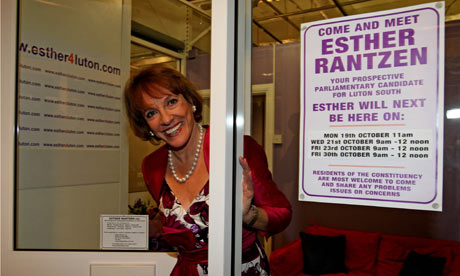
Esther Rantzen, who is standing as an independent for Luton South.

Esther Rantzen, who is standing as an independent for Luton South. Photograph: PA Wire/Chris Radburn

It's a beautiful spring morning and I'm standing outside Ealing town hall in west London, looking for the Man in the White Suit. Martin Bell, who overturned Neil Hamilton's vast Conservative majority in Tatton in 1997 to become the first independent candidate to win a seat in the Commons since 1951, is the éminence blanc of the burgeoning independent movement and is here to endorse the candidacy of Sam Akaki, a political lobbyist for CND who has chucked in his job to stand for parliament as an independent.

Though at 71 he has decided he's too old to stand himself, Bell is working hard on behalf of other independents, and has produced a set of principles for ethical political behaviour. The principles, founded on "selflessness, integrity, objectivity, accountability, openness, honesty and leadership", are so obvious that you wonder why they had to be set down, but then you remember the expenses scandal and Stephen Byers's admission that he is a "taxi for hire", and realise why it is necessary to start from scratch. The fledgling Independent Network insists that all the candidates it backs – 20 so far and rising fast as the election approaches – subscribe to the principles as a signal of their commitment to clean up parliament.

Last year, Bell published a book on the expenses scandal called A Very British Revolution. "We cannot return to where we were, which was the politics of the pig trough, because the people will not stand for it," he wrote. The revolution, however, seems a long way off on this bright spring morning. Akaki, who likes to call himself "Uncle Sam" (in an avuncular rather than a pro-American way) has gathered together about 20 supporters to hear him declare his candidacy. An independent from the neighbouring constituency of Brentford & Isleworth, a middle-aged woman with bright red hair and the magnificent name of Teresa Venneck-Surplice, has come along to lend her backing. It is a warm and friendly gathering, but it doesn't feel as if the Bastille is about to be stormed.

"I became a member of parliament entirely by accident and without intending to," Bell tells the gathering. "I had never mapped out a parliamentary ambition. It is something that happened to me, but it was a huge honour to be the first elected independent since 1951. I found there really is a useful place for independents in the House of Commons because [for them] every vote is a free vote, and you're much more influential than the lobby fodder of the backbenchers of the main parties

Click on link to read this excellent article about Independent candidates.

Posted via web from Hexham Matters

About Me

My photo
My focus is inter-spiritual living

ShareThis