Wednesday, 12 September 2012

Hillsborough: Kelvin MacKenzie, the Police and Murdoch's Sun

The 'truth' according to Rupert Murdoch's Sun newspaper

Image

The reality;

0image

I watched a lot of the TV reporting yesterday from the Hillsborough Independent Panel and related events.   One point no one mentioned yet is that the police who fed the false stories to the media have all happily been on two-thirds pension, index-linked, for life.  

We used to say about the police and politicians; "There's always one bad apple."   Now the rarity is to find people in public life and government institutions who have real integrity.  The relatives & people of Liverpool suffered for more than two decades unnecessarily. Today as usual Fleet Street Fox's take is outstanding.

Here is a quote from Fleet street Fox on the Hillsborough disaster;

It was a world where men kicking a ball around a pitch was not so much a family day out as an excuse for violence and thuggery. The police did pretty much as they pleased and journalists were not much different.

Or at least that was how it seemed to everyone else - in truth most of the football fans, coppers and hacks were decent people who did their best but were tainted by association with a handful of idiots. It was easier to cross the road, pretend not to notice them, and keep your head down.

And who can blame them? One dad out to watch the match with his boy is never going to be able to stop a horde of drunken yobs hurling concrete blocks at riot police. It is not a practical fight to pick.

So they got away with things they wouldn't today. There weren't cameras everywhere, it was difficult to know what other people were thinking, and there weren't a lot of rules.

So when 39 football fans were killed and 600 were injured when two rival groups of hooligans clashed at the Liverpool vs Juventus match at Heysel Stadium in 1985, it was easy to think that everyone involved was a murderous thug. In fact most of the dead were innocent, and in trying to escape the fighting knocked over a badly-built wall and crushed the fans sitting behind it.

In those days there were no cameras to pick out the ringleaders so 14 Liverpool ticket holders were jailed for involuntary manslaughter, and their club was barred from European matches for six years. Every other English club was barred for five.

The newspapers which have always sold millions of copies on the basis of their sports coverage blamed the 'hooligan element', and people like me grew up thinking football was about violence.

A couple of decades on we can all see hooliganism across Europe had a lot to do with Far Right agitators, and still does. And that because the 1980s saw the value of football transfers rocket as players became media stars, money that should have gone into maintaining and modernising Victorian grounds went into the pockets of players and agents.

Four years after Heysel it seemed to happen again - only this time it became the worst disaster football, the police or the newspapers had ever seen.

Liverpool fans - people then reviled by almost everyone in Britain for that European ban - delayed by unexpected roadworks turned up late at a FA Cup semi-final at the Hillsborough Stadium to watch their side play Nottingham Forest. After all the violence of the past, the stands were now separated into vast wire cages.

The man in charge of the police operation, Chief Superintendent David Duckenfield, expected only trouble.

He decided that although there were more of them them the Liverpool fans should go into the smaller end of the stadium, to avoid having to cross the path of Notts Forest fans. There were too few turnstiles and a crush developed, made worse when they decided not to delay kick-off even though thousands of people were late and still outside.

As the crush got worse Duckenfield ordered a side gate to be opened to relieve the pressure. Fans poured in, but there were no stewards to direct them into the empty areas. Instead they followed stadium signs pointing them into cages that were already packed.

Each cage should have held only 1,600 people - they ended up with more than 3,000 packed in.

As the people at the front began to climb over the fences to get out, TV commentators called it a pitch invasion. When fans began pulling down hoardings they were called hooligans in homes up and down the country, where millions watched it live on Grandstand.

Duckenfield, in his control room, decided it was thuggery. He sent a line of police officers onto the pitch to prevent fans getting to the Notts Forest end. The referee called off the match six minutes after it began. 

But as time ticked past it became clear there was more to it. The hoardings were being used as makeshift stretchers, people were being hoisted up and out of the crush by those who'd scaled the wire, and some who could not get out tore holes in the cage with their bare hands.

Sports photographers caught every second of it on film. Grandstand kept on broadcasting. The country sat on its sofa, aghast.

Forty four ambulances were called but only one allowed into the stadium. Those makeshift stretchers were turned back at the police line as they tried to get to the paramedics.

Many of the dead were children - the youngest was 10. Ninety four were killed that day, in their cage and left to die on the pitch. Two more severely-injured died later. Still others have since reported suicides, post-traumatic stress, alcoholism and other problems.

The first newspaper reports were done in a rush, for the Sunday editions. Most of the photographs, even by the gung-ho standards of the time, were too gruesome to use. Relatives were identifying the dead from Polaroids. No-one had a clear idea of what happened. Duckenfield was said to have told officials fans without tickets had forced open the side gate.

On Monday the Mirror printed photographs of fans dead in the crush under the headline 'Never Again', and as one of the first newspapers to use colour the true horror of blue faces and bloodied bodies caused huge shock.

There were angry radio phone-ins, and the paper's legendary editor Richard Stott spoke publicly about his decision and why he thought it was important to get across the true scale of what happened.

On Tuesday the Sun said the police were being made 'scapegoats' for a disaster caused by ticketless hooligans, and on Wednesday it reported claims by Tory MP Irvine Patnick and an unnamed police source that in the crush Liverpool fans picked the pockets of the dead, urinated on police and attacked rescue workers.

The reporter who pulled the story together told the editor

 Kelvin MacKenzie he was worried about it and stressed they were allegations, not facts. The 18 or so staff sent to cover the disaster and more aware of who to trust and what went wrong were in Liverpool, not the newsroom. The editor laid out a front page with the headline 'The Truth', and in the pub his hacks sat around shaking their heads and predicting trouble.

To read Fleet Street Fox's FULL ARTICLE click HERE.

The BBC's reporting is HERE

Posted via email from sunwalking's posterous

Tuesday, 11 September 2012

Mindfulness of breathing - Thich Nhat Hanh

Image
Thich Nhat Hanh teaches four exercises about mindful breathing concerning the body;

Breathing in, I am aware that I am breathing in; breathing out, I 
am aware that I am breathing out.

I breathe in, and I am aware of the length of my in-breath; 
breathing out, I am aware of the length of my out-breath.

I breathe in and I am aware of my whole body.

Breathing in, I calm the activities of my physical body.

Go HERE to read Thich Nhat Hanh's 

Mindfulness of Breathing 1 - 

Dharma Talk given on July 24, 1998  in Plum Village, France.

Posted via email from sunwalking's posterous

Buddhism and Merleau Ponty - a paper by Tran Phuoc Phuong Thao

Interesting paper

Abstract

During the last decade, many psychotherapists have successfully applied 
meditation on treatment and rehabilitation for the patients who get affected by 
depression, drug abuse or antisocial behaviors… to bring them back to normal life. 
However, to those who have the incurable illness, incompetent of living an 
ordinary life is little paid adequate attention.  Whether or not it is possible for them 
to live a good life within illness is, nonetheless, a challenging question for us. With 
a holistic approach, this paper will articulate the importance of mindful breathing 
started on the physical body as an ethical meditation so that the body can transform 
within.  Concept of the lived body in Merleau Ponty‟s phenomenology will be 
modified in the Buddhist context. The purpose is to elicit the interwoven of the 
body and the world in the perpetual perception, and the efficiency of attention will 
be cultivated in the practice of mindful breathing so as to remodel the intentional 
habit of dichotomous conception of the agency and grasping attitude. The shifting 
of inner landscape settings will give patients a fresh and creative look at the 
environing world. It is in the world that body finds itself is a life-giving, neither 
birth nor death and beyond fear even on deathbed. 

Key words: lived body, perception, attention, intention, mindful breathing, 
neither birth nor death

You can read the paper HERE

Posted via email from sunwalking's posterous

Monday, 10 September 2012

Enjoyed the Olympics? - Look what Iran does to its young people!

Banned from making their mark

Posted: 09 Sep 2012 07:03 PM PDT

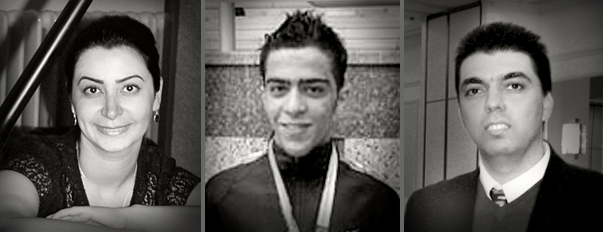
Three Iranian Baha'is who are denied the opportunity to make a distinctive contribution to their country. Pictured, from left: pianist Pegah Yazdani; judo champion Khashayar Zarei; and chess player Pedram Atoufi.
 

Three Iranian Baha'is who are denied the opportunity to make a distinctive contribution to their country. Pictured, from left: pianist Pegah Yazdani; judo champion Khashayar Zarei; and chess player Pedram Atoufi.

[BWNS, 6 Sep 2012] NEW YORK — In practically any other country of the world, a teenage chess champion, a national judo standout and a talented pianist would be valued as contributors to their society.

In the example of three young Iranians, however, being members of the Baha’i Faith has meant a ban on competing and performing at the highest levels.

Judoist Khashayar Zarei, chess player Pedram Atoufi, and pianist Pegah Yazdani are all victims of Iran’s systematic policy – spelled out in a government-backed 1991 memorandum – to “block” the progress and development of Baha’is and “deny them any position of influence.”

Khashayar’s story

As Iran brought home a record haul of medals from the 2012 Olympic Games in London, 19-year-old Khashayar Zarei could only dream of what might have been.

In his age and weight class, Khashayar is one of the country’s finest judoists. But he has been barred from competition because he is a Baha’i.

“Despite the fact that on three occasions I came first in my weight group on the national team, as a result of my belief in the Baha’i Faith, I have been banned from participating in the Asian World competitions,” Khashayar wrote in a letter published by the Human Rights Activists News Agency.

To add to Khashayar’s disappointment, he was recently stopped from pursuing his architectural studies at Shiraz University because of his religious beliefs. Officials told him they had received instructions to expel him in a confidential letter from the Ministry of Science, Research and Technology. This is also part of official government policy: that once it becomes known a student is Baha’i, he or she must be expelled.

Khashayar is not alone among Iranian youth in having his hopes thwarted.

Application forms for admission to special programs for gifted students require the applicant to specify his or her religion, allowing administrators to disqualify Baha’i candidates; there is no option to leave the section blank. One Baha’i – a distinguished year two high school student in the city of Sari – was recently expelled from her gifted school. Two others were denied the opportunity to take part in a Science and Mathematics Olympiad for prodigies. In Tehran, an outstanding Baha’i student who reached a high level in the “Robocup” technology initiative was barred from registering in a school to prepare herself for competing at the national and international levels. And in 2008, the Baha’i International Community learned how the parents of one student were told by a sympathetic school administrator that all school principals in Marvdasht had received verbal instructions to give students of “the Bahaist sect” and other minorities only a passing grade in their school examinations – regardless of their actual level of performance – so as to prevent them from being eligible to enter universities.

Chess champion

This type of exclusion is not new. After winning a national chess championship in 1991 at the age of 16, Pedram Atoufi was told he could not represent Iran at the Asian Chess Championships because he was a Baha’i.

Following the 1979 Islamic revolution, chess was banned in Iran for a whole decade. So when Pedram won the country’s first national tournament for youth in 12 years, he was thrilled at the opportunity to represent his country in international competition.

But when he went to obtain his passport, he was handed a form and told to mark his religion.

“I wrote Baha’i,” he said. “The person who was processing my form said ‘If you put Baha’i, it’s not easy to get a passport.’”

Pedram was informed that the only possibility was to visit the president of the Iran Chess Federation, who could send him on a team visa. The president, however, became enraged upon hearing that Pedram was a Baha’i and sent a letter to the Federation’s members in every state saying that Pedram was barred from competing in any official chess tournaments. That year, no one was sent to compete for Iran in the Asian Chess Championship.

Pedram’s ban was gradually relaxed over four years, leaving only a prohibition on international competition. When his team won the national championship in 1997, he was replaced and his teammates represented Iran in the international stages.

Today, Pedram lives in Scottsdale, Arizona, where he runs a club which aims to cultivate a sense of unity through chess. He cannot return to his homeland; a good friend who went to the youth chess championship with him was only recently released from jail.

Pianist in exile

The denial of higher education to Baha’is also applies to other forms of artistic and professional education.

Barred from pursuing her musical ambitions in Iran, Pegah Yazdani traveled alone to Moscow in 1998 to study piano. She cried for the whole flight.

“Emotionally it was a really tough time; I had to leave everyone behind,” she said. “At the same time I was very excited because I was going to pursue my dream.”

Completing her instruction after five years, she obtained her degree and returned to Iran to her family, hoping to perform and open a piano school.

She was offered a part-time job at Tehran’s conservatory. But when employees were asked to fill out a form asking them to mark their religion, Pegah was fired and banned from giving music lessons or playing recitals.

“If they see ‘Baha’i’ there, they don’t even look at you, they just deny the form,” she says.

“I knew I wasn’t able to do anything in Iran. I wouldn’t be able to study there. I wouldn’t be able to work. I wouldn’t be able to live there normally.”

Accepted in 2007 into the London College of Music and Media, Pegah took a masters degree in Piano Performance and now lives in Canada where she is truly engaged in music – performing, teaching piano, and also working as a ballet accompanist.

Despite her ordeal, Pegah – now 36 – says she still loves her country very much and wishes she could return. She hopes that one day soon the Baha’is that remain in Iran will be allowed to make their full contribution.

Bani Dugal, the Baha’i International Community’s principal representative to the United Nations, says the Iranian government’s strategy towards Baha’is is denying the country the benefit of a host of talents and capacities.

“The lengths to which Iran will go to prevent young Baha’is from obtaining higher education has grown more and more convoluted and extreme,” she said. “These stories are pitiful examples of a state-sponsored campaign which, in the end, only deprives Iran of the valuable and exciting contributions that could be made by some of the country’s best and brightest young people.”

—

Source: http://news.bahai.org/story/922

Posted via email from sunwalking's posterous

Wednesday, 5 September 2012

Do you know these children? - A crying shame

THIRTEEN years ago a country which had 4million or so children living in poverty announced it would do something about it.

Their leaders, just two years after being elected in a landslide, vowed to stop children growing up cold and hungry, failing at school, and being trapped in poverty their whole lives.

In fact, said the leaders, they'd wipe the problem out by 2020.

It was a great idea, rather let down by the fact it took them four years to agree how to measure poverty, nine years to get around to planning legislation, and another 18 months before the laws were agreed and came into force.

Thirteen years on, 3.6m children are still growing up poor and hungry in that country. It's predicted to hit 4.2m in the next four years - a third of all their children. Things are so bad that for the first time ever Save the Children has announced a new fundraising campaign to buy them blankets and food.

Only we're not talking about somewhere gloomy and grim in Africa. This is Britain in 2012.

GO HERE to read the full article by the brilliant Fleet Street Fox

Posted via email from sunwalking's posterous

Saturday, 1 September 2012

The cow-pat points to non-thingification - some non-God talk

Image

SOURCE - WikiPedia and a cow!

The cow-pat points to non-thingification - some non-God talk

First Thomas Merton;

‘God’ said Boehme, ‘is called the seeing and finding Nothing (RP No-thing ?)....because it (RP He/She/It) is inconceivable and inexpressible..... Rilke simply reports on the poetic phenomenology of the innocent ‘outgazing’ proper to the child, against which the child is systematically educated.  Culture teaches man to ‘be opposite’, to stand against objects, and to never be anything else but a subject confronting objects:


Always facing creation, we perceive there

only a mirroring of the free and open

dimmed by our breath.


The animal simply ‘gazes out’ without any consciousness of a centre which gazes.


…..its own being for it

is infinite, inapprehensible,

un-introspective, pure, like its outgazing.

Where we see future, it sees Everything

itself in Everything, forever healed.


We are the other hand have been ‘turned around’, and we are always aware of ourselves as spectators.  This spectatorship is a wound in our nature, a kind of original sin (here Rilke is in the Christian tradition of the Church Fathers and the Mystics), for which ‘healing’ is urgently required.  Yet we refuse healing because we insist on preserving our status as spectators.  This is the only identity we understand.  Once we cease to ‘stand against’ the world, we think we cease to exist.  (RP this is the source of Fundamentalism - see last two chapters in Terry Eagleton’s After Theory).   Furthermore we manipulate the world as we contemplate it, we arrange it to suit the whim and yearning of our vision.             pp 78-79 Thomas Merton on Zen


The above is the sense in which it is true to say ‘I am God” about which Bede Griffiths is concerned where he says;

If I am using the ordinary language of rational thought then certainly I am not God, and to say that this world is God is as false as to say that it exists of itself.  If I try to find the words to express that transcendent Reality, I have to use images and metaphors, which help to turn my mind toward the truth, and allow Truth itself to enlighten it.

                                  From Return to the Center by Bede Griffiths  in The Essential Mystics p 216 by Andrew Harvey


COMMENTARY - RP 

Within my understanding I, and you, are nothing but God - PLUS the illusions and false identity I/we have created via, as Merton says, the culture that shaped us and such negatives as cowardice and insufficient tenacity etc.  

All of God’s Creation is a manifestation or emanation of Him/It/Her - everything from the most sublime scripture to the oldest cow pat in a ten acre field!  But only the true Messengers of God, manifest without the crippling imperfections that we accrue.  Life is a challenge to let go those imperfections and let God shine through.  Nothing needs to be added, nothing needs to be searched for or acquired.  We are perfect, complete, radiant, we are God - insofar as we let go those imperfections.

Saints are those who can live in that less egoistic reality - at least 51% of the time.  

Within a panENtheistic view God is both absolutely transcendent and utterly immanent.  Coming to understand that every atom in Creation is a gateway to Him is a matter of raising consciousness, a letting go of egoistic self.  All of the ‘ten thousand’ things, as the Buddhists call the diversity of the world, point to that Whole, a Whole that we cannot thing-ify, name, or conceive of.  Religion is the codification of experiences in encountering the Mystery of the Whole.  The universal mysticism is the beating heart of all living religions.  Scripture and poetic commentary are the inevitably failed attempts at expressing the ineffable, sublime though they may be.

Insofar as we let go imperfections we become purer manifestations of the breaths of the Holy Spirit.  For this we need to  remember that sacrifice is ‘to make sacred’ - not self destruction.  Our individuality, our true self, is the admixture of names and attributes of God that we uniquely manifest - like the light reflected on water.  The particular admixture is eternal because the light is eternal.

-0-

The birds have vanished into the sky,
and now the last cloud drains away.
We sit together, the mountains and me,
until only the mountains remain.

Li Po (701-762)

Posted via email from sunwalking's posterous

Wednesday, 29 August 2012

How to destroy your children's spirituality - or not!

Image

-0-

Kids have a bad deal if we don't guard them against some of the horrors of this world.  The task of parents and teachers is challenging.

Throughout our lives we are in one of two states. 

We are either a drop thrown up by the Ocean, in which we see the world as me and 'it'.  

Or through meditation, or some other unitive experience, we are in a state of having (temporarily) laid down the burden of separate, egoistic self in favour of just Self.

“The birds have vanished from the sky,

and now the last clouds slip away.

We sit alone, the mountain and I,

until only the mountain remains.”

(8th Century) Chinese poet Li Po

Many I suppose pass through this world without the awakening that is represented by access to the unitive, non-egotistic state.  Many are called, few are chosen.

Parents have the challenging task of using the 'world of dualities' to create the individuation of the self: hot-cold, nice-nasty, acceptable-not acceptable, loving-not loving, green-not green, me-not me etc.

The more challenging dimension is to not allow 'individuation via dualities' to tip over into permanent, unbridled egotism.

Even more important is the enabling, encouraging dimensions of self that are the foundations for true spirituality in the adult.  Of course every child, thank God, is different.

Stillness is one.  Quietness is one.  Sensing the magic of a wondrous phenomenon - a horse, a cloudscape, a rushing brook another

I recall that Eckhart Tolle says that as soon as we label something - say a tree - the child never really sees that phenomenon again - at least in the sense of it's total, magical reality.

I think that is true if all we do is provide labelling answers.

To (merely) label is to dismiss.

To (merely) label is to reinforce dualities and only dualities.

When we say to a child, "In the tree there are whole wolds of animals, and water systems and capturing of sunlight." we are creating a relationship between the child and tree-ness that is not limited.  The tree is then a possible gateway to Wholeness, Oneness and an experience of laying down the burden of self in Wonder, Awe, Astonishment, Amazement.

The horrors of our celebrity world and the constant bombardment of noise to ensnare and then sell, sell, sell is one of the worst horrors waiting to capture our children for Mammon - leaving them for an adult life without the basics of true spirituality - something we should work to prevent.

Much in early life is simple: hugs, reading every day, laughing and games -  but another is also easy - vocalising our own inner spiritual dialogue:

"Sitting and having a cup of tea stops me from too much busy, busy, busy."

"I love being near a horse - I love the twitches, the breath, the horsey smell, the munching of grass - horses are magical."

"Sometimes I wonder about all the life that is in and around and beneath that beautiful tree!"

We don't even have aways to ask such key questions as, "What do you think?" or "What do you like about elephants?"

Sometimes being authentic in and through ourselves is the best we can be, and therefore do, for our children.

Posted via email from sunwalking's posterous

Sunday, 26 August 2012

Thomas Merton's defence of Thich Nhat Hanh

I was delighted to discover than a wonderful defence of the Young Thich Nhat Hanh was put up by Thomas Merton;

Image

.
This is not a political statement. It has no ulterior motive, it seeks to provoke no immediate reaction “for” or “against” this or that side in the Vietnam war. It is on the contrary a human and personal statement and an anguished plea for Thich Nhat Hanh who is my brother. He is more my brother than many who are nearer to me by race and nationality, because he and I see things exactly the same way. He and I deplore the war that is ravaging his country. We deplore it for exactly the same reasons: human reasons, reasons of sanity, justice and love. We deplore the needless destruction, the fantastic and callous ravaging of human life, the rape of the culture and spirit of an exhausted people. It is surely evident that this carnage serves no purpose that can be discerned and indeed contradicts the very purpose of the mighty nation that has constituted itself the “defender” of the people it is destroying.
 Certainly this statement cannot help being a plea for peace. But it is also a plea for my Brother Nhat Hanh. He represents the least “political” of all the movements in Vietnam. He is not directly associated with the Buddhists who are trying to use political manipulation in order to save their country. He is by no means a Communist. The Vietcong is deeply hostile to him. He refuses to be identified with the established government which hates and distrusts him. He represents the young, the defenseless, the new ranks of youth who find themselves with every hand turned against them except those of the peasants and the poor, with whom they are working. Nhat Hanh speaks truly for the people of Vietnam, if there can be said to be a “people” still left in Vietnam.

To read the article go HERE

Posted via email from sunwalking's posterous

Do you like to eat melon? - Yes, then help bees!

"Grow, grow, grow
melons!"
buzz the bees -Issa, 1809 - To receive your daily haiku go HERE 

For more on Japanese Haiku poet go HERE

Image

If you like fruit & vegetables help bees - go HERE

Photo SOURCE

0image

Photo SOURCE

Posted via email from sunwalking's posterous

Friday, 24 August 2012

Exquisitely chanted Baha'i Prayer for the Departed (Laurie Early)

O my God! O Thou forgiver of sins! Bestower of gifts! Dispeller of afflictions!

Verily, I beseech Thee to forgive the sins of such as have abandoned the physical garment and have ascended to the spiritual world.

O my Lord! Purify them from trespasses, dispel their sorrows, and change their darkness into light. Cause them to enter the garden of happiness, cleanse them with the most pure water, and grant them to behold Thy splendours on the loftiest mount.

'Abdu'l-Bahá


Laurie says:


I created this musical setting of the prayer in honor of my musical mentor, Ulysses L. Slaughter, Jr. This was the first public performance, January 4th, 2009, (not the 9th, that's a typo), at his memorial service. 

I continually dedicate my musical life to his memory.

Posted via email from sunwalking's posterous

9/11 Tribute Song - This Unforgiving Town by Laurie Early

Zen masters talk about nothing but the existence of God - in Tillich's sense

Image

How close is Paul Tillich's work to (Zen) Buddhism?

First some of Tillich's central ideas;

Tillich presents .......... God as Being-Itself, Ground of Being, Power of Being. 

What makes Tillich's ontological view of God (RP ontology = being ) different from theological theism is that it transcends it by being the foundation or ultimate reality that "precedes" all beings. 

Just as Being for Heidegger is ontologically prior to conception, Tillich views God to be beyond Being-Itself, manifested in the structure of beings.[42] God is not a supernatural entity among other entities. Instead, God is the ground upon which all beings exist. 

We cannot perceive God as an object which is related to a subject because God precedes the subject-object dichotomy.[42]

Thus Tillich dismisses a literalistic Biblicism. Instead of rejecting the notion of personal God, however, Tillich sees it as a symbol that points directly to the Ground of Being.[43] 

Since the Ground of Being ontologically precedes reason, it cannot be comprehended since comprehension presupposes the subject-object dichotomy. 

Tillich disagreed with any literal philosophical and religious statements that can be made about God. 

Such literal statements attempt to define God and lead not only to anthropomorphism but also to a philosophical mistake that Immanuel Kant warned against, that setting limits against the transcendent inevitably leads to contradictions. 

Any statements about God are simply symbolic, but these symbols are sacred in the sense that they function to participate or point to the Ground of Being. 

Tillich insists that anyone who participates in these symbols is empowered by the Power of Being, which overcomes and conquers nonbeing and meaninglessness.

SOURCE

RP - A few comments;

Tillich's 'pointings' are no different to those of a Zen master.

Buddhist teachers, especially Zen masters talk about nothing but the existence of God - and how to be a drop lost in the Ocean - until the laundry needs doing

Literalism is the death of religion because metaphor is the language of the spirit - metaphor makes room for other viewpoints - and for the infinite God, the Whole, the infinite Mystery.

Yet these also are true:

"The eye with which I see God is the same eye with which God sees me." - Meister Eckhart

"Zen is the unsymbolization of the world." - R H Blyth  (RP Try explaining that to a fundamentalist - or to a child!)

"No reason can be given for the nature of God, because that nature is the ground of rationality."  A N Whitehead  in Science and the Modern World (1925). 

Zen and the thology of Tillich teach us to live in the presence of God as that which is beyond word, concepts or any symbols - about which we are mindful when and being overcome with self.

QUESTION - So are we supposed to live constantly in mystic union with the Whole in an ego-less reverie?

Abraham Joshua Heschel provides the best answer I've ever discovered;

The search for reason ends at the shore of the known;
on the immense expanse beyond it only ‘the sense of the ineffable’ can glide.
It alone knows the route to that which is remote from experience and understanding. ‘

Neither is amphibious: reason cannot go beyond the shore,and
the sense of the ineffable is out of place where we measure, where we weigh.

Citizens of two realms, we must all sustain dual allegiance:
we sense the ineffable in one realm;
we name and exploit reality in another.

Between the two we set up a system of references, but can never fill the gap They are as far and as close
to each other…as life and what lies beyond the last breath.
A J Heschel - Man is Not Alone p8.

a more poetic and fulsome presentation of the much more cryptic;

'After the Ecstasy; the laundry'

and

"Before Enlightenment chop wood carry water, after Enlightenment, chop wood carry water." 

Duality is the goal - but duality is a vital wing in the raising of consciousness, especially in children - without a self, there is no self to lose.

It also enables us to not bump into the furniture

-0-

Posted via email from sunwalking's posterous

Tuesday, 21 August 2012

You have only 48 hours to say NO to the UK govt's law to spy on all.

Please add your voice to stopping the governments law to spy on everyone.  

The police and secret services already have all the powers they need.  

Such a law is a dangerous step toward a totalitarian state.

See here;

Posted via email from sunwalking's posterous

Wednesday, 15 August 2012

Photography as exploration of our inner life, spirituality & healing

Nick Turpin says about doing street photography,

"It makes me feel special to be there but not to be chatting, not to be shopping or not even be heading for some where else. I feel like I am invisible to the passing crowds. This in turn leads to my sense of self, which is the finest feeling of all."

Street Photography Now p207

In a spiritual context this is a statement about unitive ie mystical experience. Nick points up another ability within raised spiritual consciousness here;

"For me, pictures made in a shopping street or business district of a city reveal as much about our world as pictures made in places of international conflict or famine or environmental disaster."

Posted via email from sunwalking's posterous

Thursday, 9 August 2012

I have been converted to Swami Beyondananda

.

Steve Bhaerman is an internationally known author, humorist, and workshop leader. For the past 23 years, he has written and performed as Swami Beyondananda, the "Cosmic Comic." Swami's comedy has been called "irreverently uplifting" and has been described both as "comedy disguised as wisdom" and "wisdom disguised as comedy."

As the Swami, Steve is the author of Driving Your Own Karma (1989), When You See a Sacred Cow, Milk It For All It's Worth (1993), Duck Soup for the Soul (1999) and Swami for Precedent: A 7-Step Plan to Heal the Body Politic and Cure Electile Dysfunction (2004).

Posted via email from sunwalking's posterous

Wednesday, 8 August 2012

Authentic spirituality as 'what we do with our higher in-comprehension' - 'Radical Awareness 365 8/08/12

 
Img_1388

“Awareness of the divine begins with wonder. It is the result of what man does with his higher incomprehension. 

The greatest hindrance to such awareness is our adjustment to conventional notions, to mental clichés. 

Wonder or radical amazement, the state of maladjustment to words and notions, is therefore a prerequisite for an authentic awareness of that which is.”

                                                                                                                                                                   From Abraham Heschel’s ‘God in Search of Man’

A view of Heschel's Radical Awareness - as a 'philosophy'.

A gross but inspirational oversimplification of Radical Amazement is to be so in awe of every aspect of the world and its creator that one cannot help but do one’s part to make it the best it can be.

SOURCE 

TAGS: radical awareness, daily inspirations, art, inspiration, wonder, awe, awareness, consciousness, spirituality, authentic, spirituality, 

Posted via email from sunwalking's posterous

Rabbi Arthur Waskow discusses what we can draw from the civil rights and anti-war movements of 40 years ago

Tuesday, 7 August 2012

Jonathan Jones writes about 'mighty wordsmith' Robert Hughes

Robert Hughes
'A mightier wordsmith than most of today’s leading novelists' ... Robert Hughes, who has died aged 74. Photograph: Najlah Feanny/Corbis

Robert Hughes, who has died aged 74, was simply the greatest art critic of our time and it will be a long while before we see his like again. He made criticism look like literature. He also made it look morally worthwhile. He lent a nobility to what can often seem a petty way to spend your life. Hughes could be savage, but he was never petty. There was purpose to his lightning bolts of condemnation.


To read the article go HERE

Posted via email from sunwalking's posterous

Authentic spirituality and 'radical amazement'

                                                                To read the full article go HERE
In exploring Abraham Joshua Heschel's philosophy/way of living  'radical amazement' I cam across an inspiring blog post by Ellen Brown.  Here s a quotation from it;

Finding wonder in even the simplest and most common of things is the first step in appreciating the land. This mantra follows from the principle that humans are temporary tenants on the earth, not owners of it. Radical amazement is a form of thinking that goes beyond knowledge–its a constant attitude. It is one thing to understand science, history, math etc., but it’s another thing to be awestruck with the existence of how the world functions.

By studying and asking questions, we exhibit the will to wonder.  In the Jewish tradition, every moment and each act can become an opportunity to feel wisdom in all things. We use blessings to provide an opportunity for us to “ask permission” to use, benefit, and take pleasure from what we find in the world. According to Rabbi Abraham Joshua Heschel, “We are trained in maintaining our sense of wonder by uttering a prayer before the enjoyment of food. Each time we are about to drink a glass of water, we remind ourselves of the eternal mystery of creation.”

In this way, blessings channel us from the physical world to the spiritual world. Yet blessings are not the only way to enhance wonder. The principle of Bal Tashschit(derived from Deuteronomy 20:19) prohibits the needless waste of anything, from food to fuel. Today, using disposables, leaving lights on unnecessarily, over-utilizing the air-conditioning, or driving a car when it is not necessary might be considered a violation of this principle.

In this way, we can maintain amazement by not taking things for granted.


To read the full article go HERE

Posted via email from sunwalking's posterous

Thursday, 2 August 2012

Matthew Fox on Hildegarde and the State of the Roman Catholic Church

.

</object><div style="font-size: 10px;text-align: center; width:220px;"> Listen to internet radio with Namaste Radio on Blog Talk Radio</div>

.

Matthew Fox was born December 21, 1940 in Madison, Wisconsin. He currently resides in Oakland, California. Formerly a Catholic priest and presently an Episcopal priest, Fox is arguably the most important theologian of our time. He is certainly amongst the most controversial. A spiritual theologian and religious scholar, he has dedicated much of his life to developing/recovering the tradition of Creation Spirituality.


One can learn much about Matthew Fox's life by reading his autobiography, Confessions: The Making of a Post Denominational Priest. Not surprisingly much has happened in Matthew's life and work since the 1996 publication of Confessions. We invite you to find out what his latest projects are; he usually has several in the works at any given time.

He's currently working on a new book about Hildegard and ressurecting the balance of the Divine Feminine and Divine Masculine, published by Namaste Publishing.

.

Posted via email from sunwalking's posterous

About Me

My photo
My focus is inter-spiritual living

ShareThis