1:54:38 Watch Later Error
Marxism and Confucianism Today: Comparative Philosophies in the Eurasian Realmby UCBerkeleyEvents3,727 views
1:46:13 Watch Later Error
BBRG PRESENTS: Gayatri Chakravorty Spivak on Situating Feminismby UCBerkeleyEvents9,911 views
1:30:55 Watch Later Error
Homi Bhabha: "On Global Memory: Thoughts on the Barbaric Transmission of Culture"by UCBerkeleyEvents9,976 views
1:20:11 Watch Later Error
Garrick Ohlsson: "Why Chopin? and Other Questions"by UCBerkeleyEvents13,051 views
1:28:55 Watch Later Error
Gayatri Spivak: The Trajectory of the Subaltern in My Workby UCtelevision61,486 views
49:31 Watch Later Error
Why Marx was Right - Terry Eagleton Marxist Critic and Authorby fourmanfilms2,969 views
1:38:38 Watch Later Error
Memory, Inequality and Power: Palestine and the...by UCBerkeleyEvents34,601 views
50:11 Watch Later Error
Living in the End Times According to Slavoj Zizekby VPROinternational232,332 views
1:25:33 Watch Later Error
Homi Bhabha: Writing Rights and Responsibilitiesby UCtelevision27,095 views
47:37 Watch Later Error
Berman. Chopinby proektmedia4,462 views
52:27 Watch Later Error
1/2 Terry Eagleton: Mythologies of Marx, 21st May 2011, Subversive film festival Zagrebby SkriptaTV3,004 views
31:22 Watch Later Error
Terry Eagleton on Marxism as a Theodicyby tvochannel7,147 views
59:01 Watch Later Error
Full interview with Clifford Geertz - part oneby ayabaya33,287 views
9:51 Watch Later Error
BBC - Why I Hate The Sixties (2004) [part3 of 6]by cheesehoven7,634 views
1:03:29 Watch Later Error
Particle Physics in the 21st Centuryby UCBerkeleyEvents8,673 views
33:56 Watch Later Error
Eric Hobsbawm discusses 'How to Change the World' | Socialist History Society | 25 Feb 2011by adycousins11,284 views
5:43 Watch Later Error
Interview with Terry Eagleton Part 2by junyDada3,397 views
1:19:22 Watch Later Error
From The Anxiety to The Anatomy of Influence: A Conversation with Harold Bloomby PENamericancenter8,600 views
6:45 Watch Later Error
Terry Eagleton slams Christopher Hitchensby fromwilliams16,501 views
- Loading more suggestions...
Saturday, 14 April 2012
Terry Eagleton: "The Death of Criticism?" - YouTube


Social Theories - the first in a series of lectures by Prof Alan Macfarlane
Filmed as part of a second year course in social anthropology at Cambridge University in November 2001. For further writings on the social theorists and the background, please see www.alanmacfarlane.com
NB.
For the chart referred to here, please see:
<a href="http://fortnightlyreview.co.uk/2010/04/fragment-concepts-of-time-and-the-worl...
http://fortnightlyreview.co.uk/2010/04/fragment-concepts-of-time-and-the-worl...>
1. A map of social theories, 1000-2000 by Alan Macfarlane - YouTube
59:12 Watch Later Error
Some reflections on writing - especially dissertationsby ayabaya19,307 views
47:05 Watch Later Error
6. Lecture on Emile Durkheim (1858-1917)by ayabaya72,337 views
47:41 Watch Later Error
3. Adam Smith (1723-1790)by ayabaya53,366 views
10:10 Watch Later Error
Structuralism, Saussure and Levi-Strauss (2 of 3)by Eidos848,714 views
54:56 Watch Later Error
Justice: What's The Right Thing To Do? Episode 01 "THE MORAL SIDE OF MURDER"by Harvard3,662,884 views
44:38 Watch Later Error
21. Weber's Theory of Classby YaleCourses5,431 views
53:41 Watch Later Error
5. Lecture on Karl Marx (1818-1883)by ayabaya128,312 views
51:49 Watch Later Error
4. Alexis de Tocqueville (1805-1859)by ayabaya18,059 views
1:09:50 Watch Later Error
Terry Eagleton: "The Death of Criticism?"by UCBerkeleyEvents22,175 views
59:01 Watch Later Error
Full interview with Clifford Geertz - part oneby ayabaya33,287 views
50:24 Watch Later Error
10. Marx's Theory of Historical Materialism (1)by YaleCourses7,020 views
45:55 Watch Later Error
Introduction to anthropology (3): Origins and Historyby ayabaya3,192 views
37:06 Watch Later Error
1. Introduction: What is Political Philosophy?by YaleCourses104,509 views
52:12 Watch Later Error
Moral panics and the legal systemby ayabaya2,660 views
48:09 Watch Later Error
Interview on life and work of Richard Sennett - part oneby ayabaya2,847 views
33:56 Watch Later Error
Eric Hobsbawm discusses 'How to Change the World' | Socialist History Society | 25 Feb 2011by adycousins11,284 views
10:28 Watch Later Error
Structural Functionalismby ryancragun16,963 views
10:01 Watch Later Error
Anthony Giddens lecture part 1by gauri5557,364 views
38:11 Watch Later Error
Interview of Stuart Hall - March 2006by ayabaya11,682 views
- Loading more suggestions...


This is the first of a series of lectures on Social Theories
Filmed as part of a second year course in social anthropology at Cambridge University in November 2001. For further writings on the social theorists and the background, please see www.alanmacfarlane.com
NB.
For the chart referred to here, please see:
http://fortnightlyreview.co.uk/2010/04/fragment-concepts-of-time-and-the-worl...>
Monday, 9 April 2012
Saturday, 7 April 2012
Nan Goldin; " I don't remember much ever feeling like a child, so maybe photographing them triggers memories." Sarah Phillips Guardian interview

 One of Nan Goldin's best shots Photograph: Nan Goldin
I don't photograph adults so much any more. I don't have a child and, psychologically, my focus on them is a lot about me wishing that I did. But I am a godmother to friends' children around the world – in Berlin, New York, Sweden and Italy. I don't remember much ever feeling like a child, so maybe photographing them triggers memories.

Click on link above to read article by Sarah Phillips in the Guardian.
Goldin's art, like that of Tracy Emin, and many of us, flows from pain and from the struggle to emerge into a fuller degree of wholeness & healing.
Of course art created out of happiness and privilege can be much harder.
Wednesday, 4 April 2012
A MANIFESTO for neo-humanistic photography
Notes toward
A MANIFESTO for neo-humanistic photography
one possible application is as a resolution for dissonance between two aesthetics
i) fine art photography & ii) photographic societies/RPS aesthetics
ver 1 - 5th April 2012
CLEARING THE GROUND
Which ground needs to be cleared?
WHAT IS PHOTOGRAPHY? Like cave painting, and other visual art forms, photography is simply a way to to make marks - ones that last reasonably well.
There are broadly two classes of photography -
record photography, objective/scientific in nature, and fine art photography, subjectively expressive in nature.
These two can very occasionally morph into the other - perhaps unmade beds are an example!
Record photographs are for example police mugshots, scientific shots of the brain or rocks or animals or flora.
After 100 years the supposition is still that they = faithfully represent objective reality.
Art photographs are subjective expressions/constructions of how the artist sees or experiences the world.
Record photographs have meaning - objectively. Its conventions are set by science & special purposes e.g scientists, police etc
Fine Art photographs have meaning - subjectively. Its conventions derive from the great ongoing (art) educational dialogue.
Some of these are meaning-full for us as individuals, some are meaning-less.
The worth or value for record photography lies in verisimilitude, faithful technique to exclude subjectivity as far as possible - the focus is the thing in and of itself - for whatever is the purpose.
The frame of reference, the evaluative model, is all other photographs of, for example, red admiral butterflies, plus red admiral butterflies seen ‘in nature’ - plus the need of the ‘uses’ - such as electron-microscopy for scientific research.
Fine art photography has as its frame of reference the perpetual ‘great conversation’ that has taken place about art.
Verisimilitude was important say in the 18thC but with the invention of photography art generally took an inward turn - ‘this is how I experienced my chair and room and sunflowers and the country around Arles’.
This turning point may well have been the (genuine?) crafts-art dividing point as well.
Going inward in photography took much longer.
Was Minor White a ‘pre-inward’ photographer of the ‘spiritual’?
See the work of this guy -
Two people who really enlarge the notion of ‘internal’ are Cindy Sherman and Calum Colvin in his Ossian project.
‘Ossian’ Reviews HERE
WHAT IS ‘NEO-HUMANISTIC PHILOSOPHY’ AS USED HERE?
I distinguish between the philosophy of Humanism and the view of being human as presented by Maslow et. al. It is from within a humanistic world-view that this argument is presented.
My neo-humanistic world-view in a nutshell is as follows.
The difference between a normal healthy functioning human being and a corpse is the life-force.
I call this life-force (chi in Chinese) the human spirit.
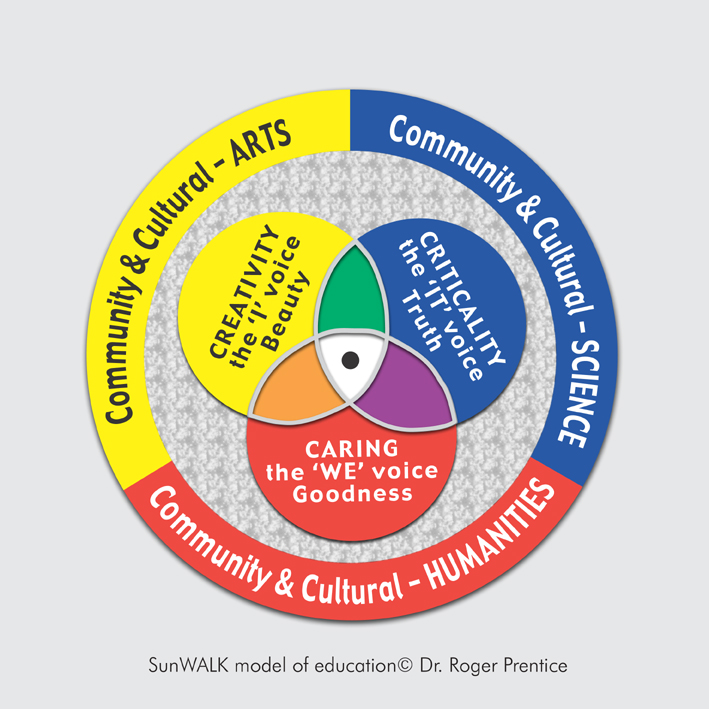
It is useful to relate the expressions of the human spirit as ‘the 4Cs’, 3 inner Cs and 1 outer C.
These are the modes & expressions of the human spirit -
with them we ‘read the world’, intuit, come to know, exchange ideas and develop levels of consciousness. (I take Archbishop Tutu to have a higher level of consciousness than Charles Manson.)
All expression can be seen as combinations ‘inwardly’ of Caring, Criticality & Creativity & ‘outwardly’ being in and via the 4th C acting in community.
INWARDLY ( intra-personally)
Caring - is the mode of our being & thinking & doing the social-moral truth sphere.
Criticality - is the mode of our being & thinking & doing in the scientific-philosophic, the objective truth sphere.
Creativity - is the mode of our being & thinking & doing in the arts, revelatory, subjective truth sphere.
OUTWARDLY (inter-personally)All the Caring, Criticality & Creativity we express, & receive, is in various levels, ‘onion rings’, of Community/ies - from friendship to families to the global family of humankind.
Culturally these three modes of expression, & of receiving the world, are the great ‘store-houses’ of the Humanities, the Sciences & the Arts
The 3 intra-personal modes Caring, Creativity & Criticality are also called the WE, I & IT voices by Ken Wilber.
The 4Cs is part of the SunWALK model which is a foundation for science, the arts & humanities, for education and for social activism. Diagrammatically it is represented in this logo;
A fuller account of the SunWALK model is HERE
DOES PHOTOGRAPHY AS A MEDIUM HAVE SOME INTRINSIC or SPECIAL IDENTITY?
Seeking the intrinsic nature of photog is as blind an alley, as seeking the intrinsic nature of brushes, pigments and canvas. Art flows from the human spirit not from the camera or paint-brushes.
Always the relevant nature lies in what it means to be human, and have human experience, including aesthetic experience. The great (and infuriatingly frustrating) Camera Lucida by Barthes is ultimately about the dynamics of the human spirit not about light-tight boxes, optics etc.
This is a vital insight:
"To me photography is the simultaneous recognition in a fraction of a second the significance of an event, as well as the precise organization the forms that give that event its proper expression." -Henri Cartier-Bresson,
but this is even more vital;
Photography is an immediate action; drawing a meditation For me photography is to place head heart and eye along the same line of sight. It is a way of life. - Henri Cartier-Bresson
except I would say that the head-heart-eye flow (ideally) secures an image that both reflects a meditative state and, in the ‘reader’, induces a meditative state.
WHAT IS AESTHETIC EXPERIENCE?
Aesthetic experience is the subjective reading, or de-coding, of the event that gives us the kind of experience we call aesthetic.
My preference is to not confine the aesthetic to ‘beauty’, but to take take ‘truth, beauty & goodness’ as the three dimensions of a single reality - that reality being the three modes, or ‘primar colours’ of the human spirit.
Often, and at best, the aesthetic experience is ‘pre-conceptual’ - thinking & talking about it, if at all, is what comes afterwards
Two haiku serve as examples;
A lightning flash:
between the forest trees
I have seen water.
Shiki Masaoka (1867-1902)
-0-
The summer river:
although there is a bridge, my horse
goes through the water.
-0-
Shiki Masaoka (1867-1902)
‘RPS’ and Fine Art photography - a collision of two aesthetics
Unlike say the miners who were ‘primitive’ and ‘folk’ artists, i.e the Pitman Painters, the RPS (?) and Clubs have successfully avoided or prevented connection with the great art conversation.
Little bits from the great conversation occasionally leak in and fine art photographs emerge in spite of the oppression, seemingly by accident - and what’s more are often recognized by judges and by many members. So what’s lacking - knowledge, appropriate language or what?
POSSIBLE CHARACTERISTICS OF THE TWO AESTHETICS - mainly negative ones to start with!
Societies/RPS
Boys with toys - anti feminine
Clockwork - non-holistic
Bourgeois
Train-spotters
Nerdiness - wonderful example of Nerdiness - aircraft cockpits HERE
Some Judges are self-indulgent, painfully ignorant, destructive in their remarks particularly toward newbies, have only vague notions of categories and appear through inconsistency to have no coherent model with which to work.
Fine art
Some say it is run by a ‘mafia’ of curators and dealers + some ‘I’ve made-it’ artists, brilliant like Hockney and less so like Tracy Emin.
Described/championed/controlled by up-their-own selves critics speaking psycho-babble - people who have no simplicity or depth.
Jay Burton on Vivian Maier | Unnatural Light
It causes one to wonder how many other Vivian Maiers there are out there with their negatives and prints filed in storage boxes, their canvases stacked in attics, their sculptures covered in garages. How many are there who don’t have the know-how to market themselves, or don’t have the interest. How many are there who make art only to please themselves. One wonders what other great art we are missing…
Saturday, 31 March 2012
The UK needs to wake up to these truths
Erskine Bowles and Alan Simpson
Personal message:
The UK needs to wake up to the truths and the spirit of what these two guys are telling America.
Friday, 30 March 2012
Wednesday, 28 March 2012
Is Photography Over? - wonderful resources from San Francisco MOMA
Is Photography Over?
Overview
Is Photography Over?: Introduction
Neal Benezra, Sandra S. Phillips, and Dominic Willsdon
Running time: 6 min. 4 sec.SFMOMA has been collecting and exhibiting photographs since the museum's founding in 1935 and is dedicated to the examination of the medium in all its forms. A major symposium on the current state of the field, held at SFMOMA in April 2010, was the first in a series of public programs on photography.
This page archives the conversation begun in the Is Photography Over? symposium. It includes video of the entire program, complete, unedited transcripts of the proceedings, and the original position statements submitted by the participants in advance of the symposium. Additional responses and reports on the two days of the symposium can be found on our blog, Open Space.
Click on link to find the whole symposium - videos and talks
Tuesday, 27 March 2012
Smartphones | Art and design | guardian.co.uk
 One of the many tributes to Steve Job set up at Apple stores around the world as news of his death spread. This one, at the Beijing Apple store, was photographed on an iPhone 4 with the Hipstamatic app. Photograph: Dan Chung for the Guardian
Smartphones are becoming ubiquitous. Most Guardian journalists are now expected to be able to take a picture with their phone which is good enough to be used in print or online. The use of apps has even crept in with a New York Times photographer using hipstamatic on an assignment.
Good article - CLICK o link to read it
David Hockney's Stephen Hawking portraits draw greats together | Art and design | guardian.co.uk
 Meeting of minds … David Hockney at work on an iPad portrait of Stephen Hawking, which is now showing at the Science Museum. Photograph: Judith Croasdell
I wrote a while ago about Jake and Dinos Chapman's horrendous and crass portrayal of the physicist Stephen Hawking in their sculpture Ubermensch. I vaguely wondered at the time what a David Hockney portrait of the same great man of our time might look like ... but had no idea he'd actually created one. Visiting London's Science Museum recently I was transfixed by a sensitive, affectionate and acute drawing of Hawking in its 70th birthday display about his life and work.
The portrait was done in the linear style of Picasso's 1920s drawings and that meant it must be by ... yes, Hockney.
Click on link to read article
Monday, 26 March 2012
Sunday, 25 March 2012
Thursday, 22 March 2012
EXTRACT Speech Transcription - Dr. Martin Luther King's 1963
May I reiterate the problem will not work itself out. May I reiterate that it is not a sectional problem. No area of our country can boast of clean hands in the realm of brotherhood. It is one thing for a white person of good will in the north to rise up with righteous indignation when a bus is burning in Anniston, Alabama with freedom riders or when a church is burned or bombed in Birmingham, Alabama killing four, unoffending, innocent beautiful girls. When in Jackson, Mississippi a Medgar Evers is shot down or when in Oxford, Mississippi, some fifteen or sixteen thousand troops are necessary for our courageous James Meredith to go to a university of that state. A white person of good will in the north must rise up with as much righteous indignation when a Negro cannot live in his neighborhood, when a Negro cannot get a job in his firm, when a Negro cannot join his professional society, when a Negro cannot join his fraternity or her sorority. In other words, if this problem is to be solved there must be a sort of divine discontent all over this nation.
There are certain technical words within every academic discipline that soon become stereotypes and cliches. Modern psychology has a word that is probably used more than any other word in modern psychology. It is the word "maladjusted." This word is the ringing cry to modern child psychology. Certainly, we all want to avoid the maladjusted life. In order to have real adjustment within our personalities, we all want the well-adjusted life in order to avoid neurosis, schizophrenic personalities.
But I say to you, my friends, as I move to my conclusion, there are certain things in our nation and in the world which I am proud to be maladjusted and which I hope all men of good-will will be maladjusted until the good societies realize. I say very honestly that I never intend to become adjusted to segregation and discrimination. I never intend to become adjusted to religious bigotry. I never intend to adjust myself to economic conditions that will take necessities from the many to give luxuries to the few. I never intend to adjust myself to the madness of militarism, to self-defeating effects of physical violence. But in a day when sputniks and explorers are dashing through outer space and guided ballistic missiles are carving highways of death through the stratosphere, no nation can win a war. It is no longer the choice between violence and nonviolence. It is either nonviolence or nonexistence, and the alternative to disarmament. The alternative to absolute suspension of nuclear tests. The alternative to strengthening the United Nations and thereby disarming the whole world may well be a civilization plunged into the abyss of annihilation. This is why I welcome the recent test-ban treaty.
In other words, I'm about convinced now that there is need for a new organization in our world. The International Association for the Advancement of Creative Maladjustment--men and women who will be as maladjusted as the prophet Amos. Who in the midst of the injustices of his day could cry out in words that echo across the centuries, "Let justice roll down like waters and righteousness like a mighty stream." As maladjusted as Abraham Lincoln who had the vision to see that this nation would not survive half-slave and half-free. As maladjusted as Thomas Jefferson who in the midst of an age amazingly adjusted to slavery would scratch across the pages of history words lifted to cosmic proportions, "We know these truths to be self-evident, that all men are created equal, that they are endowed by their creator certain unalienable rights" that among these are "life, liberty, and the pursuit of happiness." As maladjusted as Jesus of Nazareth who could say to the men and women of his day, "Love your enemies, bless them that curse you. Pray for them that despitefully use you." Through such maladjustment, I believe that we will be able to emerge from the bleak and desolate midnight of man's inhumanity to man into the bright and glittering daybreak of freedom and justice. My faith is that somehow this problem will be solved.
In spite of the difficulties of this hour, I am convinced that we have the resources to make the American Dream a reality. I am convinced of this because I believe Carlyle is right. "No lie can live forever." I am convinced of this because I believe William Cullen Bryant is right. "Truth pressed to earth will rise again." I am convinced of this because I think James Russell Lowell is right. "Truth forever on the scaffold, Wrong forever on the throne; Yet that scaffold sways the future, And behind the dim unknown, Standeth God within the shadow, Keeping watch above His own." Somehow with this faith, we will be able to adjourn the councils of despair and bring new life into the dark chambers of pessimism. With this faith, we will be able to transform the jangling discords of our nation to a beautiful symphony of brotherhood. This will be a great day. This will be the day when all of God's children, black men and white men, Jews and Gentiles, Protestants and Catholics will be able to join hands and sing in the words of the old Negro spiritual, "Free at last! Free at last! Thank God, Almighty, we are free at last!" Thank you. [APPLAUSE]
Click on link to read whole speech by MLK
Wednesday, 21 March 2012
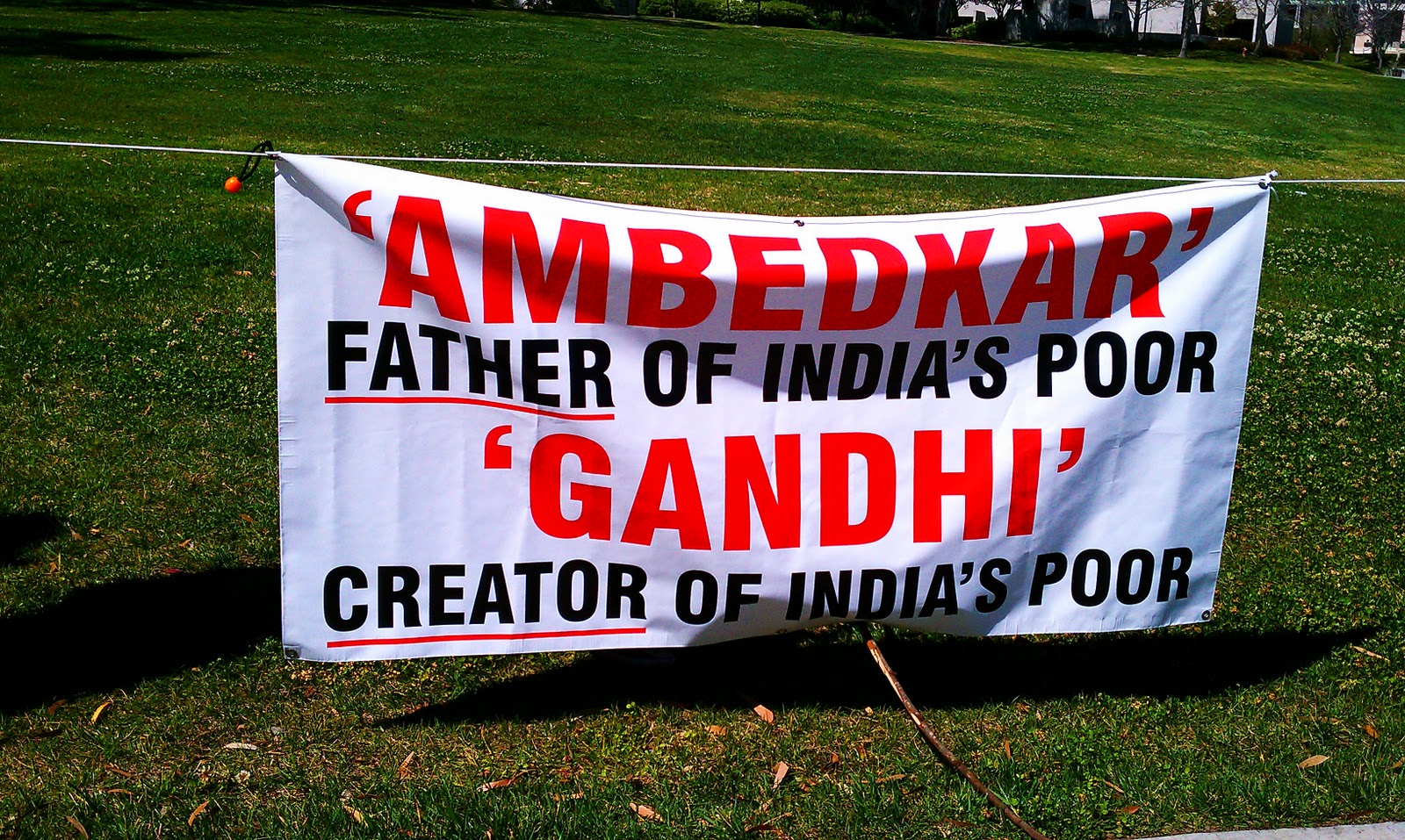
Gandhi and the Dalit controversy: The limits of the moral force of an individual / Waging Nonviolence - People-Powered News and Analysis
A protest sign at an anti-Gandhi rally in San Diego last year reveals the tensions that still exist between India's independence leader and minority groups.
When I first heard that Gandhi was viewed as “the enemy” by many Dalits in India (formerly called “untouchables”), I was dumbfounded. How and why could Gandhi be seen as having betrayed the Dalits when he opposed untouchability even in the face of active discomfort on the part of close associates?
Last month, while I was in India teaching Nonviolent Communication to 120 people, including a significant number of Dalits, I had the opportunity to explore this question further. During a session called “Gandhian Principles for Everyday Living,” a topic about which I have written at length, one of the 60 people present expressed anguish, pain and anger towards Gandhi. He was a Buddhist, like many other Dalits who had chosen to follow the Dalit leader Dr. B. R. Ambedkar in leaving behind centuries of mistreatment under Hinduism.
Click on link to read article
Tuesday, 20 March 2012
Twitter buys Posterous!

Hi
I’m thrilled to announce that Posterous has been acquired by Twitter!
The opportunities in front of Twitter are exciting, and we couldn’t be happier to bring our technology and expertise to hundreds of millions of users around the globe. Plus, the people at Twitter are genuinely nice folks who share our vision for making sharing simpler.
Posterous Spaces will remain up and running without disruption. We’ll give users ample notice if we make any changes to the service. For users who would like to back up their content or move to another service, we’ll share clear instructions for doing so in the coming weeks.
You can find more information answers to other questions you may have here.
Finally, I’d like to offer thanks to everyone, especially those who have been with Posterous since day one. The last four years have been an amazing journey. Your encouragement, praise and criticism have made Posterous better, and I really appreciate everything you’ve done.
Thanks again and I look forward to building great things for you at Twitter.
- Sachin
-0-
Good luck - hope we get new goodies and don't lose any of the existing ones!
Good luck and hope we don't lose all the good things about Posterous!
Saturday, 17 March 2012
Sunday, 11 March 2012
'The greatest feat of controlled strength ever?' - from Cirque du Soleil's - 'Quidam'
Still can't believe what these two do - or the beauty of it!


 Posts
Posts


